Showing posts with label missile. Show all posts

The Current State of North Korea’s Satellite and Missile Facilities

January 11, 2020 Add Comment

Rocket engine test at the Sohae Satellite Launch Station |Photo: Rodong Sinmun, April 9, 2016

Over the decades, North Korea has decentralized its satellite and missile launching facilities across its territory. One obvious benefit to this is security but it is done at the cost of efficiency. The more facilities one has, the more resources are necessary to maintain and upgrade them. It may even become necessary to neglect or demolish a site in favor of improving more important ones. Pyongyang seems to have learned this lesson and placed some sites in caretaker status, demolished others, and concentrated resources to support their core infrastructure.

In this article, I will examine the current state of the country’s launch and testing facilities and detail a few important changes that have happened under Kim Jong Un, who has overseen a greater number of missile tests than his predecessors combined.

While North Korea has a history of launching missiles from a range of locations (factories, airfields, and even along highways), the country does have a robust set of dedicated launching and testing facilities.
Currently, the country has two satellite launch sites, three rocket engine test facilities, a general launch facility, and two former sites that have been decommissioned in recent years. Within Pyongyang, two known tracking and control centers also exist.


Satellite Launch Sites

While all countries have the right to peaceful space exploration, the development of rocket engines to carry satellites or astronauts necessitates the development of ballistic technology. Indeed, this has been a concern of other nations regarding the development of private space exploration. North Korea’s official protests that their space program is solely peaceful have never been taken seriously by the West and even their own propaganda has occasionally betrayed the rouse. Most recently, the purpose of the December 2019 engine tests at the Sohae Satellite Launch Station have been described by state media as “bolstering up the reliable strategic nuclear deterrent of the Democratic People’s Republic of Korea”.

Image showing the rebuilt vertical engine test stand |Photo: Google Earth

Located on the western seaboard, initial construction activity at Sohae (also known as Tongch'ang) was first noticed in the early 1990s and was largely completed by 2011. The first test occurred on April 13, 2012, with the failed launch of the Kwangmyŏngsŏng-3earth observation satellite.
Improvements to the site continued to be made over the years including new administrative and observation facilities, an upgraded rail station, and even the establishment of an outer perimeter fence that encompasses the original complex and its inner perimeter. In terms of recent activity, there are three primary examples.

The first occurred in 2018. As a result of the first US-DPRK summit that was held in Singapore, North Korea began dismantlingkey structures. However, rapprochement didn’t last long and in March 2019 the second change happened, the launch pad structures began to be rebuilt. The third change came with the end of 2019 and underlined the continued importance of Sohae, as two rocket engine tests were carried out.

The county’s second satellite launch station, on the other hand, has largely remained in caretaker status since 2013.

Tonghae Satellite Launch Station (also known as Musudan-ri) is in North Hamgyong Province along the east coast. Considerably smaller, Tonghae’s construction started in the 1980s and was originally used in the development of early generation Scud missiles. In 1998, North Korea claimed to have launched a Kwangmyŏngsŏng-1 satellite from Tonghae, however, no orbital object was ever located or tracked by outside observers.

Another failed satellite launch attempt happened in 2009. In 2012, one of the last major additions to the site was constructed. The site, which has yet to be positively identified, is either a test facility or possible missile silo. However, despite initial progress, it was never completed. The most recent Google Earth imagery shows that it may actually be in the process of demolition.
Much of the trench covering has been removed and the control building has been torn down.

In May 2018, the trench covering was visible, and the control building was still standing |Photo: Google Earth

By November 2019, the covering had been partially removed and the control building demolished |Photo: Google Earth

Tonghae’s launch pad appears to be abandoned and is overgrown, while activity at the engine test stand and assembly building remains minimal. In fact, the grounds of the assembly building have been used for crop harvesting activities.

The original launch control building, tracking station, and the “new” control building (construction finished ca. 2015) have all seen little activity and signs of minor disrepair are visible. The Horizontal Processing Building has never been completed, despite construction starting in 2012.
Tonghae’s situation may be the result of the regime’s focus on launching satellites at Sohae with its superior facilities, testing missiles on mobile platforms, and keeping engine test stands near other required infrastructure, whereas Tonghae sits miles away from manufacturing and fuel production facilities. Tonghae’s future use seems rather bleak.

Rocket Engine Test Facilities

Beyond the engine testing facilities within both satellite stations are three additional test sites: at the Tae-sung missile factory (Pyongyang), the Magunpo solid-fuel engine test site (near Hamhung), and the Sinpo engine test site.

The Tae-sung rocket engine test stand as seen after a 2016 modernization program |Photo: Google Earth

The vertical test stand at Tae-sung (also called Chamjin) is located within the Tae-sung Missile Factory complex in Chollima, Pyongyang. Though the fairly rudimentary site can test engines for Scud and Nodong missiles, it underwent a period of general inactivity from 2006 to 2016. In 2016 the facilities were modernized, and a nose cone test was carried out. This suggests that testing larger engines may no longer be feasible (or necessary as other purpose-built sites exist) but that the site can still play a role in developing other aspects of ballistic missile technology.

Magunpo engine testing facility |Photo: Google Earth

Magunpo is one of North Korea’s newest testing sites (along with Sinpo). Vertical and horizontal test stands were constructed between 2013 and 2014. It also lies a mere 3 km from the No. 17 Explosives Factory in Hungnam where solid rocket propellant is produced. Since its construction, multiple tests have been carried out (as well as the launching of several missiles from the nearby Yongpo airfield to the southwest). Magunpo remains an important cog in North Korea’s missile program as it is currently the largest such site in the country.

Sinpo engine test stand |Photo: Google Earth

Within the city of Sinpo and including the nearby Mayang Island lies a key submarine base and is where most of the development of submarine launched ballistic missiles (SLBM) occurs. Initial work on the land-based test stand began in 2012 and supports “both the development of the Pukguksong-1 (KN-11) SLBM and SINPO-class SSBA’s missile launch systems,” according to Joseph Bermudez. There have been several “ejection tests” at the site as well as tests carried out on sea-based, submersible barges. The most recent barge-based test was of the Pukguksong-3(KN-28) which was conducted on October 2, 2019.

Work at the submarine base has been ongoing and, according to 38 North, the use of Synthetic Aperture Radar (SAR) "revealed the presence of the North Korean SINPO-class experimental ballistic missile submarine (SSBA) and its submersible test stand barge positioned beneath a recently constructed, dockside awning designed to conceal and environmentally protect these vessels.” 
This is strong evidence that the development of SLBMs is a primary focus of the regime.

Hodo Launch Site

The Hodo missile launch site and artillery testing grounds |Photo: Google Earth

The Hodo Launch Site is a dedicated missile launch facility that lies on the Hodo Peninsula, north of Wonsan. The area has been used for artillery training since the 1960s but within this decade the training area has been increasingly used for long-range artillery and ballistic missile testing. Concrete launch pads, a dock, and other support buildings were constructed beginning in 2014.

Two launch pads were constructed at the relatively close-by Wonsan-Kalma International Airport in 2016 and several tests were carried out there, however, the subsequent construction of resorts and hotels along the same beach meant that those launch sites were demolished. Since then, activity at Hodo has greatly increased with several tests happening in 2019 including a teston May 4, 2019 and two short-range missile testsoccurring in July.

Decommissioned Launch Sites

The first decommissioned launch site in recent history was the aforementioned site at Wonsan. Those two pads were the location of several high-profile launches including a Hwasong-10 launch which Kim Jong Un himself oversaw. The extremely basic facility was demolished for expediency as Wonsan was about to undergo an enormous construction project to build beach resorts. The upgraded facilities at nearby Hodo also meant that Wonsan became redundant.

A comparison image showing the Iha-ri driver’s facility with the test stand visible in 2017 and in 2019 after its demolition |Photo: Google Earth

Perhaps the most significant change happened at the Iha-ri military driver training base in North Pyongan Province. Between 2016 and 2017 a vertical engine test stand was constructed at the base. It was only used once, as a canister-launched ballistic missile ejection test for the Pukguksong-2 (KN-15) before being demolished in mid-2018 as part of Kim Jong Un’s April 2018 announcement that they would suspend future ballistic missile tests. The base has since been returned to its original purpose.

Control Centers

Pyongyang is host to the country’s central missile and satellite control centers.

The General Rocket Control Center is located within the Second Academy of Natural Sciences (also known as the Academy of Defense Science or the Sanum-dong missile factory) in northern Pyongyang. It is responsible for tracking and other activities related to the testing of ballistic missiles and was constructed sometime between 2001 and 2005. The facility has remained largely unchanged except for a new hexagonal building that was constructed in 2016. The Academy lies adjacent to the Kim Jong Un National Defense University which also plays a role in the development of missile technology.

The General Satellite Control Center is the control center of the National Aerospace Development Administration. The modern-looking complex was constructed near central Pyongyang along the Pothong River between 2014-2015. It handles satellite launches and tracking. An expansion of the facility began in 2017 with multiple large buildings being added to the complex. Construction at the site has carried on well into 2019. The exact purposeof these new buildings is unknown, but it is possible that they may be research facilities and will also provide museum space.

Conclusion

While some facilities may have been shuttered or demolished, the core of North Korea’s testing infrastructure and their ability to research and to construct missiles and launch vehicles remain undiminished. Pyongyang’s insistence that the recent Sohae tests were part of their nuclear deterrence, and their ongoing work toward developing SLBMs at their Sinpo facilities, clearly demonstrate the regime’s intentions. The question becomes, will the international community listen to what North Korea is broadcasting with the current state of their testing facilities?


I would like to thank my current Patreon supporters: Kbechs87, GreatPoppo, and Planefag.

Missile Bases & Major Underground Sites

October 23, 2019 Add Comment

North Korea is perhaps the most militarized country in history. As a country roughly the size of the US state of Pennsylvania, it has literally thousands of distinct military sites: air defense, training bases, coastal artillery batteries, airbases, missile sites, tunnels, and much more. Because of the country's nuclear program, their missile bases receive a lot of attention. However, there is still a lot that is unknown about these sites, in part, because North Korea has only officially acknowledged a handful of them (and often just in vague terms).

The satellite facilities at Sohae, Tonghae and the Chiha-ri missile base are fairly well known, but the good folks over at Beyond Parallel (part of the Center for Strategic International Studies) estimate there may be as many as 20 undeclared ballistic missile bases and related support facilities. The 2017 release of "Phase II" of the AccessDPRK mapping project listed over 9,500 military points of interest, and since then, I have begun work on the next part of the map which now includes an additional 1,500 military sites. Using this unpublished version, I decided to see what likely missile bases and large underground facilities exist in the country. (These stand-alone underground facilities are something Beyond Parallel isn't looking at.)

After going through every identified military base, tunnel, underground facility (UGF), known and suspected missile base, and other sites, I was able to locate 18 known and possible ballistic missile bases, the two satellite launch stations, and 39 large UGFs that are separate from the missile bases.


North Korea considered the creation of a ballistic missile program soon after the Korean War and it became an official goal as early as 1965, with Kim Il Sung saying the country needed to have rockets that could fire as far as Japan. From then until the early 1980s, the regime laid the foundations of the program including the acquisition of Soviet and Egyptian technology. In 1984 they were able to test their first indigenously produced missile which was a variation of the SCUD-B.

The height of their missile program came with the first internationally verified successful orbital insertion of a satellite into space in 2012, the Kwangmyŏngsŏng-3 Unit 2, followed by the 2017 test of the Hwasong-15 missile which can reach nearly all of the United States.

The vast size of North Korea's missile program infrastructure (dozens of locations in a country the size of Pennsylvania) helps to ensure that they can continue to carry out attacks if one or several bases are destroyed during a war. It also makes it all the more difficult for Western powers to keep track of the movement of weapons and equipment.

North Korea's ballistic missiles and ranges. Image from the Center for Strategic International Studies

By 2017 the country was thought to have around 900 short-range missiles, though that figure may have grown to 1,000+ with the apparent development of a North Korea-produced clone of the Russian Iskander missile. (As well as from the continued production of known missile systems.)
Short-range missile are typically defined as having a range of 1,000 km (620 miles) or less. Examples include the KN-02, Hwasong-6, and the aforementioned Iskander clone.
Medium-range missiles have a range of 1,000-3,000 km (620-1,860 mi). Examples include the Rodong-1 and Pukkusong-2 (KN-15). North Korea likely has 500 or fewer of these missiles.
Intermediate-range missiles can reach 3,000-5,500 km (1,864-3,418 mi). An example is the Hwasong-12. There are likely fewer than 250 IRMBs.
ICMBs (intercontinental ballistic missiles) have a range exceeding 5,500 km (3,400 mi). North Korea's Hwasong-15 is their latest developed ICBM. There are probably fewer than 75 operational missiles in this category.

The country's missile bases are divided into three main "belts". They are, with increasing distance away from the DMZ the, "tactical belt", "operational belt", and "strategic belt". The different belts reflect the types of missiles deployed at each base, with the strategic belt holding long-range missiles (this includes the submarine base at Mayang) and the tactical belt being the site of shorter-range missiles aimed at the DMZ, Seoul, and other important South Korean sites.

Pyongyang's missile program is under the control of the Korean People's Army (KPA) Strategic Forces and the construction of the bases is done by KPA Unit No. 583 (the Military Construction Bureau). Substantial construction began for many of the bases in the late 1980s to mid-1990s, and construction at all sites had either already began or was scaled up by the 2000s. Several ballistic missile bases, such as Chiha-ri and Yusang-ni, have had upgrades since Kim Jong Un came to power.


A note on naming. Unless a name has been given in an official North Korean or US-ROK alliance intelligence source, all of the locations talked about in this article are otherwise named for the nearest populated place as listed by OpenStreetMap. A lack of standard naming has led to confusion for years, but that's one thing this article seeks to remedy. And, instead of simply saying "a base in Chagang Province" or "by Kimchon-ni" (when there are multiple villages with the same name), this article will list the base's exact coordinates.

These twenty main facilities occupy approx. 362.5 square kilometers of territory. Despite my best efforts, I wasn't able to positively identify the To'gol base (allegedly in Pyongsan County) or the Kittaeryong base (in Anbyon County).


Within the "tactical belt" are:

1. Chiha-ri - Coordinates are: 38°36'10.63"N 126°44'12.20"E
2. Kal-gol - Coordinates are: 38°40'3.15"N 126°44'49.97"E
3. Kumchon-ni - Coordinates are: 38°57'54.14"N 127°36'8.48"E. Kumchon-ni has been detailed by Beyond Parallel.
4. Sakkanmol - Coordinates are: 38°34'59.81"N 126° 6'29.91"E. Sakkanmol has been detailed by Beyond Parallel.
5. Sing'ye - Coordinates are: 38°38'24.31"N 126°40'48.26"E. Sing'ye is one of the smallest missile bases in the country. It may also be the source name for the Hwansong-class of missiles as a nearby village is named Hwasong, and the base was constructed early on.
6. Suthae-ri - Coordinates are: 38°22'51.67"N 127°29'0.55"E. Suthae-ri is a possible base and hasn't been mentioned in any media that I could find. At less than 10 km from South Korean territory, it would be the closest ballistic missile base to the DMZ. The base doesn't have the "drive thru" bunkers that many other known bases have, but it does have a large and expanding underground facility and several bunkers of other types.

Chiha-ri, Kal-gol, and Sing'ye are all within 5 km of each other, which would lead me to believe that they are connected in some way; perhaps in mutual-supporting roles.

Within the "operational belt" are:

1. Hodo - Coordinates are: 39°24'30.31"N 127°32'5.63"E. The Hodo base is very small and is more for testing missiles than as an operating base during conflict. Hodo seems to have replaced the beaches at Wonsan for testing sort-range missiles, as the site at Wonsan is now a cluster of hotels.
2. Hwajil-li - Coordinates are: 39°11'52.58"N 125°23'56.93"E. Hwajil-li is listed by the Nuclear Threat Initiative as a missile base that was constructed in the 1980s. Current satellite imagery doesn't show anything that would suggest the site is currently used as a missile base. A basic air defense battery and associated facilities is all that exists today.
3. Ongpyong - Coordinates are: 39°19'33.69"N 127°19'50.68"E. It is a smaller base and its facilities may be dispersed throughout a larger area.
4. Singsong-ri - Coordinates are: 39°21'32.23"N 125°45'49.57"E. Singsong-ri is a possible base. Like Suthae-ri, it doesn't fit the design of a lot of other known bases, but it does have three underground entrances which run deep into a mountain. If it is indeed a base, it's likely used to store missiles and equipment.
5. Yusang-ni - Coordinates are: 39°26'51.58"N 126°15'30.33"E. Yusang-ni has been detailed by Beyond Parallel.

On average, the land area used by these bases is smaller than bases in the other two belts.

Within the "strategic belt" are:
This belt includes the country's two satellite launching stations as they have played a role in the development of ballistic missile technology and could be used as launching sites.

1. Hoejung-ni - Coordinates are: 41°22'21.64"N 126°54'46.14"E. Hoejung-ni is one of the newest missile bases to be constructed. It is only a few kilometers from the base at Yeongjo-ri
2. Kusong-ri (alleged) - Coordinates are: 39°59'51.22"N 124°34'16.80"E. According to Jane's/IHS, this surface-to-air missile base also houses some Nodong missiles.
3. Riman-ri (Yongnim) - Coordinates are: 40°29'2.94"N 126°30'1.65"E
4. Sangnam-ri - Coordinates are: 40°50'20.20"N 128°32'35.82"E. Sangnam-ri has been detailed by Beyond Parallel.
5. Sinpo-Mayang - Coordinates are: 39°59'42.09"N 128°11'43.98"E. Sinpo houses part of a large submarine base (the other half being on Mayang Island) and has a missile test stand. The base is where North Korea is developing their submarine launched ballistic missiles.
6. Sino-ri - Coordinates are: 39°38'57.32"N 125°21'36.37"E. Sino-ri has been detailed by Beyond Parallel.
7. Sohae Satellite Launch Center - Coordinates are: 39°40'6.88"N 124°42'30.44"E
8. Taegwan - Coordinates are: 40°18'34.10"N 125°16'17.02"E
9. Tonghae Satellite Launch Center - Coordinates are: 40°52'13.09"N 129°38'34.10"E. My discovery of a missile test stand being constructed at the site was the basis of my very first #AccessDPRK post back in 2013.
10. Yeongjo-ri - Coordinates are: 41°19'44.56"N 127° 5'35.38"E. Once considered a nuclear site, Yeongjo-ri is actually a missile base.

The next area I want to explore is the collection of large underground facilities (UGFs).

As mentioned earlier, these UGFs are not part of any obvious missile base. Underground sites abound in North Korea and serve as active and reserve storage sites for weapons, equipment, food, and other supplies, and they allow for artillery to be fired and then rolled back into the tunnel for protection against counter strike. There has been a lot of speculation about the number of tunnels and underground sites within the country with some estimates going as high as 100,000. Based on the work for AccessDPRK, the real figure is much closer to 1,000 sites (some may have multiple entrances, but they're part of a single facility). Most of them are small and some are used as underground factories. But there are a few dozen (39 to be exact) which are much larger than any of the others (excluding underground industrial sites).


Some of them are placed at military bases and consist of a single complex while others exist as clusters, especially in Pyongyang.

There are four UGFs in Chagang Province.
1. Oil-rodongjagu UGF - 40°59'53.82"N 126°46'51.12"E
2. Janghang UGF - 40°57'32.66"N 126°41'9.98"E
3. Kanggye-Puji UGF - 40°53'12.75"N 126°38'4.45"E
4. Jonchon UGF - 40°32'49.08"N 126°19'48.21"E. This facility is across from the Riman-ri (Yongnim) missile base and so may be connected to it in some way.

There are three UGFs in S. Hamgyong Province.
1. Toksan UGF - 40° 1'52.84"N 127°35'48.28"E
2. Sinphung UGF - 39°58'7.64"N 127°50'17.89"E
3. Songhung UGF - 39°22'54.97"N 127°10'43.71"E

There are five UGFs in Kangwon Province.
1. Chongdu-ri UGF - 38°22'2.71"N 128° 2'20.19"E
2. Wondong-ri UGF - 38°24'51.14"N 127°41'59.76"E
3. Konsol-li UGF - 38°29'30.47"N 127° 0'7.53"E. The UGF here is part of a new military base that was constructed in 2016-2017.
4. Jisang-ri UGF - 38°34'44.13"N 126°44'5.59"E
5. Kubong-ri UGF - 38°37'44.89"N 126°43'15.55"E

There are four UGFs in N. Hwanghae Province.
1. Phyongwon UGF - 38°46'42.16"N 126°27'47.77"E. This has a very large UGF and might actually be part of their missile infrastructure.
2. Taephyong UGF - 38°26'5.60"N 126°20'37.53"E
3. Misan-ri - 38°34'41.50"N 125°56'6.04"E. This is a set of two enormous bunkers.
4. Okhyon - 38°22'4.16"N 125°44'22.81"E

There are 23 UGFs in Pyongyang. Eleven of them are in three clusters. Each cluster will only get one set of coordinates.
1. Pyongyang Group 1 - 39° 5'58.09"N 125°49'48.07"E. There are three large tunnels/entrances that spread out in an east-west line approx. 1 km long.
2. Pyongyang Group 2 - 39°10'11.96"N 125°51'28.16"E. This is a set of five large tunnels that are along a valley between two sets of hills. From the coordinate given, a rectangle is formed by a line running 1.4 km west to east and then from that point, north to south for ~0.5 km.
3. Pyongyang Group 3 - 39° 5'54.07"N 125°57'1.50"E. This is a group of three tunnels that are all located within the same hill, encircling it.
4. Pyongyang Single UGF - 39° 6'43.85"N 125°58'24.30"E
5. Taedonggang Large UGF - 39°10'25.07"N 125°56'43.60"E
6. Taedonggang Smaller UGF - 39°10'31.77"N 125°56'46.76"E
7. Samdung UGF - 39° 1'32.28"N 126°12'56.77"E
8. Rodgon-ri UGF - 38°57'54.22"N 126° 2'27.51"E
9. Sangwon UGF - 38°49'39.49"N 126° 5'23.32"E
10. Chunghwa UGF - 38°52'28.51"N 125°48'23.32"E. This UGF is within the Air Defense & Combat Command HQ complex.
11. Sunwha UGF - 39° 0'52.08"N 125°36'15.03"E
12. Kanchong UGF - 38°51'34.16"N 125°33'15.48"E
13. Kangso 1 - 38°52'55.87"N 125°30'57.91"E
14. Kangso 2 - 38°52'46.98"N 125°31'48.32"E

Here are a few examples of these underground facilities.


Patreon Special Access
Patreon supporters at the $20 tier are entitled to exclusive data sets. The Google Earth file for this post is one of those exclusive offers. This is the only nationwide map of these facilities within the public domain that contain accurate geolocation data and additional information. The file also has over 300 specific sites of interest within the various missile bases for your research pleasure. Please consider supporting me on Patreon and get access to this and other exclusive data sets.

I would like to thank my current Patreon supporters: Kbechs87, GreatPoppo, and Planefag.

--Jacob Bogle, 10/22/2019
Patreon.com/accessdprk
www.JacobBogle.com
Facebook.com/JacobBogle
Twitter.com/JacobBogle

Rockets and Runways

January 30, 2018 Add Comment
Kim Jong Un observing the Sept. 15, 2017 launch of a Hwasong-12 ICBM at the Pyongyang-Sunan International Airport. (Source: KCNA)


Kim Jong Un is well on his way to becoming the most prolific builder since his grandfather, Kim Il Sung. There are the new roads, the billions spent on construction projects in Pyongyang and in other major cities, modernizing airports and constructing new ones, and much more. Kim Jong Un has been busy as he enters his seventh year in power.

Those further changes to North Korea's military airbases and other runways, as well as the stunning advancement of their ballistic missile program makes it necessary for me to write, once more, about the ever-progressing nature of North Korea's military. There are three main areas of focus for this post. The first is the construction of multiple new aircraft parking revetments at new and older emergency runways. The second is the construction of more emergency runways. And the third deals with the possibility of the merging of North Korea's major airbases and ICBM program.


North Korea has 111 airports, airbases, heliports, emergency highway runways, and other landing strips. Particularly since 2016, nearly all of their emergency highway runways (straight sections of road that have been widened for use by aircraft in the event of a war) have had aircraft parking revetments constructed to augment each site. Additional basic runways have also had revetments constructed. In all, 15 airfields have had new revetments constructed. The number of revetments varies between one and four (most have three), but there is a grand total of 39 individual revetments which could support a combined 75 aircraft (at least) depending on type and parking arrangement.

It's important to note that not all of the satellite imagery of all of the different air facilities in North Korea has been updated to include either 2016 or 2017 imagery, so it's possible there are other sites that have had revetments constructed. I just can't yet see them.

Here are some examples of these sites. Click on any image to see an enlarged view.


Since my 2015 article on the North Korean Air Force and the changes that have happened under Kim Jong Un to the physical infrastructure of the Air Force and general aviation, at least three additional runways have been constructed.

Changdo, Kangwon Province (38.67993°, 127.72681°)


This runway is also approx. 3 miles (4.8 km) north of a military training base that underwent fairly substantial expansion in 2013.

Chongjin, North Hamgyong Province (41.80234°, 129.85480°)

This small auxiliary runway was constructed in early 2016.


Sunchon, South Pyongan Province (39.44058°, 126.03576°)

This runway is being constructed across from the large Sunchon Cement Factory. Curtis Melvin at North Korean Economy Watch believes that this will be a new 'executive' runway for use by Kim Jong Un and other high ranking officials. What makes it odd, in my mind, is the fact there are two large military airbases (and a helicopter base) within 12 miles (19 km) of this new runway - after all Sunchon is an important industrial city.
Perhaps the 30 minute drive was a bit too much for the Supreme Leader.


North Korea has a history of testing missiles from their airports, particularly at Wonsan (Kalama) and Pyongyang International. During the modernization and expansion of Wonsan, an observation facility was constructed as well as two concrete launch pads on the beach. And as you can see in the opening image of this article, Kim Jong Un observed the test of a Hwasong-12 ICBM from Pyongyang International. But unlike Wonsan, the Pyongyang launch was carried out on the bare ground.

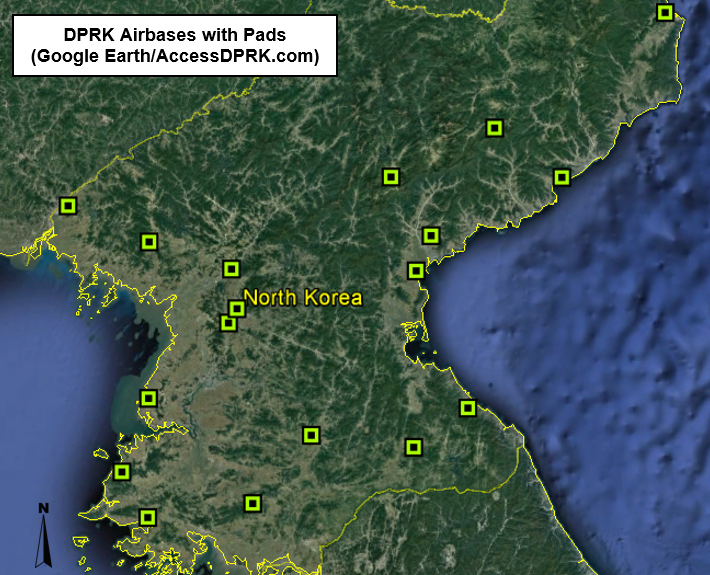
Along the line of launch pads, there has been a curious development at 19 of North Korea's major air facilities. Starting in 2015 and extending into 2016 (such a busy year), twin squares of concrete began to pop up at these airbases. Unlike the small launch pads seen at Wonsan or other sites, which are approx. 60 x 80 feet (18 x 24 meters), these new pads are each roughly 165 x 140 feet (50 x 43 meters). All but two airbases have two of these pads, one at each end and directly in line with the runway's path, but not connected to it. The other two just have a single pad. Most are made of concrete, but a few are simply areas of cleared land and compacted dirt.


My initial thought was that these were helipads, but they're much larger than most helipads in the country. Additionally, these are military bases and space already exists for helicopters. Furthermore, Pukchang Airbase (near Sunchon) has an adjacent helibase with dozens of helicopters stationed there, yet the main airbase also has these new pads. Use of these sites for helicopters is also lessened because the pads aren't directly connected to the runway and are separated from them by around 170 feet (51 m).

I am not an aviation expert, but I have explored the globe via Google Earth (and been to a few airports) and I have yet to see this layout anywhere else. My second thought then became, what if these are actually meant to allow rapid deployment of various missile systems? (Their size would accommodate everything in North Korea's arsenal.) I have asked for the input of others but wasn't able to get much more than "that's plausible", with no other firm alternative explanations. So perhaps North Korea now has 36 new ICBM launching sites, or maybe it's something else entirely. The fact these things popped up across the country, basically overnight, are fairly uniform in size, and are only located at major military sites, impels me to at least bring attention to them.


These two images shows the pad area at Kaechon Airbase before and after construction.


This next set of images is just a sample of different bases with the pads.


Here is the list of coordinates for each of the airbases with these pads.
Changjin: 40.36680°, 127.26304°
Hwangju: 38.65468°, 125.78629°
Hyon-ni: 38.61354°, 127.45410°
Iwon: 40.36044°, 128.71995°
Kaechon: 39.76226°, 125.91326°  (only has one pad)
Koksan: 38.68810°, 126.60147°
Kuum-ni: 38.86713°, 127.90625°
Kwail: 38.42360°, 125.02213°
Nuchon-ni: 38.23767°, 126.11891°
Onchon: 38.90914°, 125.23311°
Orang: 41.43005°, 129.64906°
Panghyon: 39.92883°, 125.20714° (Panghyon is near the site of the July 4, 2017 ICBM test)
Pukchang: 39.50491°, 125.96567°
Sondok: 39.75929°, 127.47621° (only has one pad)
Sunchon: 39.41134°, 125.89543°
Taetan: 38.13016°, 125.24616°
Toksan: 39.98743°, 127.60276°
Uiju: 40.15111°, 124.49965°


My ego isn't so fragile that I can't handle correction. If you think (or know) I have misidentified these sites or can offer a plausible alternative, please let me know!


--Jacob Bogle, 1/30/2018
www.JacobBogle.com
Facebook.com/JacobBogle
Twitter.com/JacobBogle

New launching/landing sites constructed?

January 06, 2017 Add Comment
UPDATE: These have been confirmed as emergency parking positions for jets, since highways can be used as auxiliary airfields (and North Korea does have at least 14 official "emergency highway strips").


On the heels of Kim Jong-un suggesting that the country is very close to testing another ICBM, I've discovered three sites that could be used as dedicated mobile-missile-launcher pads.

These sites were constructed in 2016 and have the same general design.

The first and largest is near Kaesong and lies less than 10 miles (16 km) from the Demilitarized Zone with South Korea.

Located adjacent to the Pyongyang-Kaesong Highway, by the village of Haeson-ri, this site was under construction in March and had been completed by October 2016.

Each pad is 45 feet (14 meters) wide and the straight portion is 175 feet (53 meters) long. The area around it also contains numerous bunkers and tunnels.

The second site is in Pyongsong, South Pyongan Province, which is 21 miles (34 km) north-northeast of the center of Pyongyang.


Just like the Kaesong site, this one is located adjacent to a main highway. In this case, National Highway 65. The area also has a high concentration of HARTS (Hardened ARTillery Sites), which are marked by the red dots. Several additional military facilities are also nearby.


Lastly, the third site is similar in its size and the fact it's right off a highway, but its design is different. The primary difference is a lack of a central berm. This site is located near Sukchon, also on South Pyongan.


If these are indeed dedicated pads for launching missiles, it would be in line with North Korea's continued modernization and expansion of their offensive capabilities.

________________________________________________________________________________________
I'd like to make a quick note about the #AccessDPRK Mapping Project. Across North Korea, I have located 9,500 military related places. I have finished the primary mapping process and am now working on incorporating the work of two others into a main and comprehensive single file. After that, the entire body of work will be published.

--Jacob Bogle 1/6/2017
www.JacobBogle.com
Facebook.com/JacobBogle
Twitter.com/JacobBogle

The Nuclear Question

March 20, 2013 Add Comment

Kim Il-sung, North Korea's founder, had seen the devastation wrought by the bombs dropped on Japan in WWII and witnessed the obliteration of the Korean Peninsula by Allied forces during the Korean War. Almost from the start Kim Il-sung desired to develop his own nuclear weapons program. But his desires were placed on hold as more pressing issues were on the table at the end of the Korean War, namely, rebuilding the country and completing his restructuring of the entire economy, military, and culture.

With the Soviets as allies, North Korea felt relatively safe from American "imperial aggression" and so they went about more basic national concerns. However, they engaged in lower level nuclear activities with the USSR. In 1956 their scientists were given basic knowledge on how to begin a nuclear program and in 1959 the DPRK and USSR signed a "nuclear cooperation" agreement.

The collapse of the USSR marked the beginning of many changes in North Korea. It precipitated the famine, helped to wreck their economy, and a few years later they restarted their nuclear program after losing their primary defensive shield - the Cold War threat of all out nuclear war with the ruin of the US. Their nuclear program had been on hold since 1994 but in 1998 they tested a ballistic missile and restarted processing nuclear fuel.

Today, North Korea lacks any ability to sustain a long-term, full-scale war. Most of their tanks and other weapon systems are around 25-30 years old and many sit idle or broken because North Korea lacks sufficient fuel, replacement parts and even bullets. But we should not let that lull us into a false sense of security. The North Korean soldier is one who is strongly motivated, loyal to the point of religious zealotry, and is constantly reminded that all of their problems are directly caused by the US.

For us, the Korean War ended in 1953. For the North Koreans, it's still happening. The country's leadership knows full well that without Soviet and Chinese support during the War the North Koreans would have been wiped off the face of the earth...and they very nearly were. And so today, they see South Korea flourishing, they see thousands of US troops stationed in the South and they realize they probably can't count on Russia or China in the event of a new war. At the same time, they also remember that prior to the early 1980's they had a stronger economy and better infrastructure than their southern cousins. So, what is a tiny country with a schizophrenic superiority/inferiority complex to do?

Their insistence on developing a serious nuclear defense program is one we find difficult to understand. After all, the money they've spent pursuing this goal could have fed the entire population for several years. We have to realize that what the national leadership does is for its own survival alone and not necessarily for the well-being of ordinary citizens.

For decades, North Korea has promoted itself to its people as a strong nuclear power and fully capable of sending satellites into space; at the forefront of any and all technologies. The reality is that they're bumbling about with little to go on except what they learned via the Soviets and their interactions with Iran, Syria and Iraq. Their brightest scientists are decades behind the modern world. And so, in an effort to ensure their legitimacy in the eyes of the people, and to reap the benefits of aid monies and arms deals, they have become hellbent on developing nuclear weapons and all the ancillary technologies that goes along with it.

The military is the lifeblood of North Korea. The official policy of North Korea is "Songun" (military-first) which means, in essence, the entire purpose of the nation, its economy, agriculture, technology, everything is to serve and enhance the military. And while the Kim family seems like they have had an iron-fisted grip on the county's affairs the reality is that they (more precisely, he; Kim Jong-un) must maintain an uneasy alliance between himself and the military leadership. It would go a long way toward cementing his rule if the military was well taken care of, which would include a nuclear arsenal.

This leaves us with a few questions:
What about sanctions?
What is the real threat?
Where does all this leave us today?

The first question deals with sanctions. The US and UN has levied multiple rounds of sanctions against North Korea since 2004. The problem with this is sanctions more often than not hurt the people of a country more than the leadership. Sanctions have attempted to squeeze the ruling elite into submission, in reality they have played right into their hands. The sanctions have drastically limited the amount of fuel oil and other necessities flowing into the country thus exacerbating their economic problems and hampering the ability of everyday Koreans to thrive. Exceptions have been made in the realm of food aid but this too has had a negative effect. By their very nature any aid that goes to North Korea must first go through government bureaucracies and the military is usually the one who ends up with the aid. Then soldiers take truck loads of food and sell it on the black market fueling the corrupt and the terminal kleptocratic state of the country.

The international community has also failed to realize that what constitutes "luxury goods" to the West is not what people in North Korea consider luxury. A simple TV is a luxury good in the North, not necessarily a gold-plated toilet. And the elite have had little problem getting their "luxury" goods since the UN doesn't provide a strict list of what exactly luxury means, rather they let each member country determine what is or isn't.

Sanctions, normally US led, also fits into the propaganda. By engaging in sanctions and severely harming their domestic economy the North can easily blame all their woes on the US and can use them as an excuse to use their sovereign imperative for self-defense by citing a "need" for a nuclear deterrence. So, while sanctions may make the West feel good about "stopping a rouge regime", the North is busy working their starving people into a frenzy of anti-American sentiment, ready to wage war at the drop of a hat. Not to mention that despite sanctions the North has recently tested two nuclear devices and multiple long-range rockets. Sanctions are clearly not working.

Furthermore, North Korea is not as dependent on outside help as one might expect. Their successful "satellite" launch in 2012 was a prime example. Based on the examination of rocket parts found in the ocean the world was shocked to discover that much of the rocket was domestically made. North Korea also has a fair amount of natural uranium deposits (32,000 TONS of pure uranium to be exact). Uranium enrichment is a rather straightforward process and the technical skills needed to produce a uranium-based nuclear device is much less than needed to produce a plutonium bomb. All of this tells us that while sanctions may make things difficult for the North, they are not preventing them from moving forward with their programs...obviously.

The next question is a rather simple one, what is the real threat?

North Korea, more a socialist nightmare than utopia. A broken economy and starving people with an obsolete military. What could they possibly do? Well, obviously they can build nuclear weapons and place objects into orbit and we dismiss or poke-fun of North Korea at our own risk.

There is no way the North could currently launch a nuclear missile (or any missile) at the US mainland and even dream of hitting it with any certainty. Theoretically, they could however send a bomb over in a shipping container. The North has been able to maintain an arms, drug and information trade with multiple nations the world over so it is conceivable that they could blow up the Port of Los Angeles by sneaking something on board one of the 8 million shipping containers (using another country as a 3rd-party mediator) that flow through the port. After all, ports are a notorious weak spot.

More realistically, I think we should focus on South Korea and the mood within the North. When Kim Jong-un came to power as a young, European educated man, the world hoped for real reforms. Unfortunately, it seems that the young Kim suffers from youth induced arrogance and a desire to prove himself to his people (undoubtedly egged on by seasoned and hawkish military advisers). The North has also been "gearing-up" for war since 1953 and I imagine that the citizenry is growing tired of constant war propaganda without ever releasing the tension.

Historically, North Korea has engaged in small hit & run tactics such as the sinking of the ROKS Cheonan and the bombing of Yeonpyeong Island or limited incursions. In fact, the North has technically violated the terms of the 1953 Armistice 221 times. So there is little question that the North is capable of hits, the question is, are they ready to engage in a full blown war? Politically speaking, the time is ripe for an escalated conflict. We've seen the North take provocative actions but now South Korea has also stepped up its rhetoric. The newly elected ROK (Republic of Korea) president has made it clear he is willing to be much more aggressive in the face of any threat from North Korea and this willingness on both parts will make it very easy for an otherwise small event to blow up into war.

North Korea maintains a secretive and elite rapid strike force of about 180,000 men. These troops are well trained in asymmetric tactics and have a network of tunnels beneath the DMZ which, in the event of war, means that the South could be taken off guard as 180,000 enemy soldiers surround their forward defensive lines. Additionally, Seoul is within reach of thousands of field guns and rocket launchers which could inflict massive damage. North Korea could use its 500-forward deployed, long-rang guns to rain down 500,000 shells an hour for several hours. All of this would result in up to 1 million South Korean casualties within the first few days of war. Not to mention the rest of the North Korean military which in terms of raw numbers dwarfs the South's. And while the North lacks any real ability to engage in a sustained invasion, the goal may not be to "win." Like the Taliban, the goal could be to bleed the US dry. We would be forced (by treaty) to send large amounts of aid and soldiers to back up the 28,500 US soldiers already stationed in the South and to help the South Korean military. The disruption in trade between the US and South, as well as the disruption of South Korea's overall $560 billion in global exports, could cause very real economic problems for the "enemies" of North Korea.

In the end, North Korea would be turned into a pile of ashes, as was the case during the Korean War but, not without costing the US and its allies a great deal first.

What do we do now?

I doubt North Korea genuinely wants an all out war. The end game of war would be bad for everyone involved. It is more likely that the North is simply wanting some breathing room. If it weren't for their nuclear program it's doubtful the world would even give the North the time of day. But there can be a positive outcome. Although sanctions haven't worked to stop their weapons programs, they have succeeded in making life very hard for them and rumors of assassinations and internal power struggles surface from time to time.

I think it is time we re-evaluate our position with North Korea. The North is like a spoiled child and our approach to keep him from doing bad things is by starving him to death. To me, this doesn't sound very wise -or moral. It is obvious that all of their bellicose language has been in an attempt to gain attention and aid. It is equally obvious that the international community lacks the ability to stop the North from doing as they please since they have a fair amount of domestic capability (even if it's at the expense of other sectors). At the height of the Cold War, during the Cuban Missile Crisis, both sides understood that any escalation would result in both sides losing. There is no doubt that while we would technically win the war, we would also lose it. Sanctions against the USSR did little to stop their activities and in the end the USSR collapsed from internal forces and a never-ending asymmetric war in the Middle East.

Today, the US trades with many of our mortal enemies, Russia, China, Germany, Japan, Vietnam etc. Russia and China maintain militaries that could easily take our military to task if pushed to. Russian and Chinese human rights abuses are well known and their systems of government and economics are not the same as America's. That being said, the lives of modern Russians and Chinese are better now than at any point in history and at the same time the Chinese Communist Party has never been stronger. I am not saying that their horrid human rights record, or the deaths of millions caused directly by their governments should be ignored. I am saying that there are ways of opening up societies, of making lives better, without bombing the hell out of them or holding such threat above their heads. As is evident by Iraq, Afghanistan and Libya, you cannot bomb "freedom" into a culture unable or unwilling to accept it. Sometimes change must be gradual.

The US and China have been at odds over rare-earth metals and there is a grave threat to the world economy if China decided to play bully. North Korea, surprisingly enough, has up to $6 trillion (yes, trillion) in rare-earth metals. Would it not make more sense to extend an olive branch to the North Koreans, to not demand the end of their ruling elite, and instead allow them to implement gradual economic reforms while we reap the benefit of another source of needed materials? Economic freedom breeds personal freedom. The only way for North Korea to really benefit from their natural resources is to change their economic model and in doing so the yoke of serfdom which pervades North Korean society will naturally lessen.

As long as we threaten them directly or indirectly, they will never relent. Morally, North Korea does have every sovereign right to defend itself and to develop nuclear technologies, and we have no moral (or Constitutional) right to stop them. We do have the moral and legal right to trade with them and if they launched an actual attack against us then fine, we'll erase them from the universe. I would rather have a country of full bellies which still has a Kim leading it than further continue a nation where 1/3 of those under 5 have stunted growth as a result of malnourishment with a Kim leading it.

I think we owe it to the millions of starving North Koreans, to our South Korean friends, and to ourselves to try a new path. Instead of holding on to Cold War fears and maintaining policies which clearly do not work, let us engage.

Additional Reading:
Timeline of North Korea's nuclear program, Wikipedia
Study on nuclear terrorism against US trade, Abt Associates (PDF)
North Korea's nuclear program, International Institute for Strategic Studies

--Jacob Bogle, 3/20/2013
www.JacobBogle.com
Facebook.com/JacobBogle
Twitter.com/JacobBogle

New Missile Test Site

February 20, 2013 Add Comment
North Korea has been interested in developing nuclear weapons since the 1950s. Prior to the collapse of the Soviet Union, the North was able to receive large amounts of financing and technology to pursue their nuclear agenda. However, when the Soviet Union fell North Korea also entered into a period of devastating famines and economic ruin. Despite this the government, under the policy of Songun (military-first), continued to funnel as many resources as they could into their weapons program at the expense of the population's well-being. Today, they still suffer from chronic food shortages and their economic capacity is far smaller than in the 1980's but they have managed to spend billions on nuclear and ballistic missile technology.

Their 3rd nuclear test was on February 12, 2013 and had a suspected yield between 12-21 kt (similar to that of the bomb dropped on Hiroshima). The test was conducted underground in the northeast of the country and registered as a 5.1 magnitude earthquake. This test came a few months after a successful launch which the international community agrees was actually a long-range rocket test in the guise of a domestic satellite launch.

North Korea is one of the most militarized countries on Earth and the landscape is littered with military sties ranging from small outposts to massive secret bases. One of these bases is a missile test site, the Tonghae Satellite Launch Site, seems to be growing. It is located on the coast of the Sea of Japan (East Sea of Korea) and is surrounded by small villages and rugged terrain.

The site has multiple testing facilities and rocket stands. I seem to have found a new test stand in the process of construction. The image below shows you the site in 2010 (left) which is nothing but empty ground and the image on the right is from 2012. As you can clearly see, there is a large structure being built. The layout and design is indicative of a new test stand.

(click for larger image)
Coordinates: 40° 51' 29.47" N 129° 41' 11.56" E

Only time will tell what will happen with this new site, but if the past is any indicator North Korea is well on its way to advancing their missile technology with no signs of slowing down. 

--Jacob Bogle, 2/20/2013