One of canditates for MPA is Leonardo ATR 72 (photo : Italian Navy) KUALA LUMPUR: The Royal Malaysian Air Force (RMAF) is diligently pursuing the acquisition of three major assets to bolster its maritime surveillance capabilities. Newly-appointed RMAF chief General Datuk Seri Ackbal Abdul Samad said the assets comprised unmanned aircraft systems, maritime patrol aircraft (MPA) and ground-based radars. “These are vital elements to shore up the air force which needs such requirements to meet the challenges ahead. “We are in the process of procuring the assets in due course under our ‘Capability Development 2055’ or ‘CAP 55’ programme (transformation plan on new procurement, enhancement and upgrading of assets by the year 2055),” he said in his maiden media briefing as the 19th RMAF chief at the RMAF Subang base near here. Ackbal, who turns 58 on Sept 4, succeeded General Tan Sri Affendi Buang, who was appointed the new armed forces chief on Thursday.
One of canditates for MALE UAV is General Atomic MQ-9B Sea Guardian (photo : Force India) The RMAF was reportedly seeking up to four MPAs, six medium-altitude long-endurance (MALE) unmanned aerial vehicles (UAV) and several ground-based radars. Among the MPAs the RMAF was believed to be considering were France’s Airbus C-295, the ATR 72 from Italy’s Leonardo, the United States’ Boeing P-8A Poseidon, Japan’s Kawasaki P-1 and CN-235 from Indonesian Aerospace. The MALE UAV contenders appeared to be from China’s Wing Loong II from AVIC, the US’ General Atomics MQ-9 Guardian, Turkish Aerospace’s Anka and Falco from Leonardo. It was also reported that the US would be furnishing Malaysia with 12 ScanEagle drones by 2022 through a maritime security initiative to boost the country’s reconnaissance and surveillance capabilities. It is learnt that the RMAF was also trying to procure Light Combat Aircraft (LCA), multi-role combat aircraft and ground-based missiles to replace its ageing assets.
One of canditates for ground-based radar is Lockheed Martin AN/TPS77 (photo : radar tutorial) These would ensure it stays relevant by shaping its war-fighting capabilities to deter and contain threats. Earlier, Affendi took the salute as the outgoing RMAF chief during a parade in his honour. He later presented Ackbal, who was previously RMAF deputy chief, with the rank of lieutenant-general, his promotional “four-star” rank and the baton of command. Affendi said the appointment of Ackbal and the impending appointment of RMAF education and training commander Lieutenant-General Datuk Mohd Asghar Khan Goriman Khan were most appropriate for the country’s air force, given their experience and service records. Affendi, along with Ackbal and Asghar, are trained jet fighter pilots. (NST)
Passive combination of new generation radar made in Vietnam (photo : BaoDatViet) Recently, the domestic defense industry has launched many generations of modern radar realm both active and passive. According to figures published by the Stockholm International Peace Research Institute - SIPRI of Vietnam, Vietnam has been in the payroll of the extremely advanced Vera-NG passive radar complex produced by the Czech Republic. Parameters provided by the ERA as CA Company of OMNIPOL Group (Czech Republic), the Vera-NG passive radar operates in all weather conditions, has a reconnaissance range of 400 km with an error of 20 m, stick close to 200 targets simultaneously with parameter update time: 1 - 5 seconds. With advanced technology and reconnaissance methods, they can "see" the B-2 stealth aircraft from a distance of 250 km, helping the air defense units to actively change their combat readiness state first at least 10 minutes. Despite being a modern product, which is considered a leading product in the segment, this weapon still has a disadvantage as an imported product, which does not guarantee absolute confidentiality because the specification has been made public.
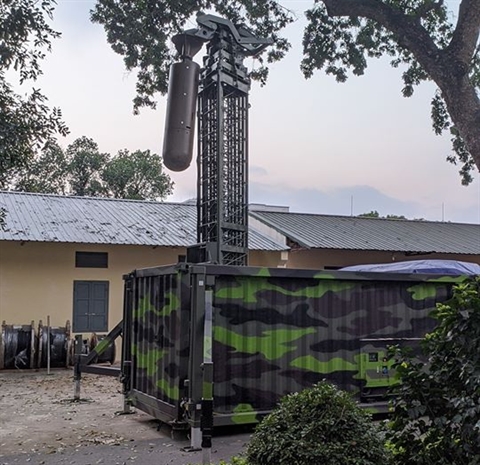
Therefore, the need to localize and create a passive radar station with similar features has been urgently set. Given the current level of Vietnamese science and technology, this task is not difficult. Not long ago, the first image of a mobile radar station using active phase array antenna technology (AESA) manufactured by Vietnam appeared, creating a premise for our own production. Passive electronic reconnaissance stations like the Vera-NG. Not to wait long, recently the special equipment made by Vietnam in the country has started to undergo testing, observing outside can realize its shape quite similar to Vera-NG, here most likely due to localization. Besides, it can be seen that Vietnamese products are much more mobile and compact, when the entire complex is folded into a container and mounted on the chassis of the tractors, making it easy to take to the different battlegrounds. With recent successes in manufacturing radar types, we can think of the prospect that after producing enough quantities to meet domestic requirements, Vietnam will move to export to get more money. reinvestment in national defense activities. (BaoDatViet)
AJAS-1000 electronic reconnaissance - jamming system is on display at Viet Bac Exhibition 2019 (photo : BaoDatViet) Defense Fair Exhibtions named Viet Bac took place in Thai Nguyen City with the presence of many very modern weapons and weapons. Within the framework of Viet Bac Exhibition 2019, besides the appearance of the most modern weapons on the payroll of the Vietnam People's Army such as the main battle tank T-90, infantry fighting vehicle BMP-2 or Pechora-2TM medium-range air defense missile complex also has very special weapons. Attracting the most attention of visitors is the AJAS-1000 electronic noise reconnaissance system created by the German company PLATH Gmbh, this is the first time this extremely modern weapon has been carried away for public exhibition.
The AJAS-1000 Brigade 84's electronic jamming reconnaissance system is in combat readiness (photo : BaoDatViet) First introduced in early 2010, however, information about the AJAS-1000 electronic and reconnaissance combination was only limitedly published by PLATH Gmbh. AJAS-1000 (AntiJam Antenna System) is an electronic warfare system specializing in tracking, zoning, reconnaissance and suppression on UHF/VHF digital shortwave (from 100 - 1,000 MHz) based on the principle source orientation.
This system is capable of suppressing radio communication equipment and transmitting shortwave digital data at close range. PLATH itself is a company with more than 60 years of experience in the field of communication, electronic warfare, especially jamming and repressive equipment. The AJAS-1000 has a modular design that makes it easy to mount on a variety of vehicles. At the request of Vietnam, PLATH has integrated AJAS-1000 on Russian-made 4x4 KamAZ-43253 truck chassis.
AJAS 1000 (photo : NetNews) For the AJAS-1000, the use of the KamAZ-43253 chassis helps to optimize the complex's combat capability, when all equipment including control stations, antennas and transmitters are put together on one frame. single roar. This helps the deployment and recovery process be shortened, improving vitality and maintaining long-term combat capability. In addition, the use of KamAZ-43253 chassis makes operation and maintenance of technical specifications become simpler than on Western chassis models or on conventional motor vehicles. According to the manufacturer's introduction, Vietnam is now the second customer of the AJAS-1000 electronic jam reconnaissance complex, the first buyer is the Federal Army of Germany. (BaoDatViet)
Salah satu produk Baynar Makina adalah UCAV Bayraktar (photo : ssb) Mahathir, Erdogan adakan perbincangan dua hala di Putrajaya Perdana Menteri, Dr Mahathir Mohamad, mengadakan pertemuan dua hala dengan Presiden Turki, Recep Tayyip Erdogan di Perdana Putra, Putrajaya hari ini. Perbincangan selama kira-kira 45 minit antara kedua-dua pemimpin negara itu diadakan di luar Sidang Kemuncak Kuala Lumpur 2019. Selepas pertemuan itu, Dr Mahathir dan Erdogan turut menyaksikan pertukaran beberapa dokumen perjanjian antara kedua-dua kerajaan dan perniagaan kedua-dua negara dalam pelbagai bidang. Perjanjian tersebut, antara lain, merangkumi kerjasama dua hala dalam bidang sains dan teknologi. Malaysia diwakili Menteri Tenaga, Sains, Teknologi, Alam Sekitar dan Perubahan Iklim, Yeo Bee Yin, manakala Turki oleh Menteri Industri dan Teknologi, Mustafa Varank. Pasa majlis tersebut, sejumlah 13 pertukaran dokumen perjanjian antara entiti perniagaan kedua-dua negara itu dalam bidang pertahanan turut berlangsung. Antara lain ialah memorandum perjanjian (MOA) antara Sapura Secured Technologies Sdn Bhd dan Aselsan Electronic mengenai domain komunikasi ketenteraan dan memorandum persefahaman (MOU) antara Havelsan Hava Electronic dan AMP Corporation Sdn Bhd mengenai Radar Pengawas Pantai.
Havelsan coastal radar (photo : Hurriyet) Selain itu, pertukaran dokumen juga melibatkan MOU antara Tijan Galaxy Aerospace Consortium Sdn Bhd dan Baynar Makina mengenai kerjasama, rakan perkongsian, perkongsian ilmu dan pertukaran teknologi berhubung pesawat tanpa pemandu (UAV) dan perkhidmatan. Presiden Turki itu tiba di negara ini pada tengah hari tadi bagi menghadiri Sidang Kemuncak Kuala Lumpur 2019 yang bertujuan menangani isu-isu berkaitan ummah dan negara Islam. Erdogan akan menyertai Dr Mahathir - selaku pengerusi sidang kemuncak itu - dan beberapa pemimpin negara Islam pada sidang tersebut di ibu negara bermula hari ini hingga Sabtu ini. Sidang Kemuncak Kuala Lumpur antara lain bertujuan membincangkan dan mencari jalan penyelesaian baharu serta yang boleh digunakan untuk masalah yang menimpa dunia Islam, dan menyumbang ke arah memperbaiki keadaan umat Islam dan negara-negara Islam. Ia juga bertujuan untuk membentuk jaringan antara pemimpin Islam, cendekiawan, ulama dan pemikir di seluruh dunia, serta menghidupkan semula tamadun Islam. (MalaysiaKini)
Radar 3D RAT 31 yang akan dibangun LEN bersama Leonardo (photo : Leonardo) Jakarta, CNN Indonesia -- PT LEN Industri (Persero) menargetkan mampu memenuhi 35 persen kebutuhan pengadaan alat utama sistem senjata alias alutsista nasional di Kementerian Pertahanan (Kemenhan) dalam lima tahun ke depan. Target ini sejalan dengan keinginan Presiden Joko Widodo (Jokowi) untuk mengurangi impor alutsista. Direktur Utama LEN Industri Zakky Gamal Yasin mengatakan target itu akan dikejar secara bersama-sama oleh para perusahaan negara di bidang industri pertahanan, misalnya PT Dirgantara Indonesia (Persero) dan PT PAL Indonesia (Persero). Saat ini, para BUMN baru bisa memenuhi sekitar 13 persen kebutuhan pengadaan alutsista Kemenhan. "Harapan kami bisa memenuhi sekitar 35 persen dalam lima tahun ke depan, kalau bisa malah per tahun mencapai 30 persenan. Khusus LEN, tahun lalu kami penuhi dengan nilai kontrak Rp1 triliun, tahun depan diupayakan mencapai Rp2 triliun," ujar Zakky kepada CNNIndonesia.com di Kementerian BUMN, Selasa (3/12). Untuk mengejar target tersebut, sambungnya, perusahaan bersama para rekan kerja tengah mengkaji dan memetakan pembangunan industri pertahanan sekaligus alutsista dalam negeri. Salah satunya mengoptimalkan pemenuhan bahan baku agar Tingkat Kandungan Dalam Negeri (TKDN) bisa mencapai 50 persen sampai 60 persen, sehingga impor bahan baku bisa dikurangi. Selain itu, Kemenhan pun, kata Zakky, tengah mendata apa saja kebutuhan pengadaan alutsista mereka ke depan. Tujuannya, agar industri nasional bisa bersiap untuk memenuhi setiap komponen alutsista secara jangka panjang. Kemudian, para perusahaan negara juga terus memetakan kerja sama yang mungkin dilakukan dengan rekan kerja dari luar negeri agar pengembangan industri serta transfer teknologi bisa terjadi. Penjajakan dilakukan dengan negara-negara di kawasan Eropa, Rusia, hingga Amerika Serikat.
Radar 2D yang sudah mampu dibikin LEN (photo : Jane's) "Misalnya juga pesawat tempur, kan kami belum bisa buat sendiri, maka kami jajak kerja sama dengan Korea Selatan, apakah bisa alternatif pesawat tempur ke depan, begitu juga kapal selam. LEN sendiri mau fokus penuhi kebutuhan radar dulu," jelasnya. Pimpin percepatan persiapan kluster pertahanan Di sisi lain, perusahaan juga memaksimalkan kerja sama di dalam negeri dengan rencana pembentukan kluster industri pertahanan bersama PTDI, PT PAL, PT Pindad (Persero), dan PT Dahana (Persero). Sebelumnya, kelima perusahaan pelat merah dikabarkan akan membentuk holding perusahaan dengan induk PTDI. "Sementara ini baru kluster, mungkin nanti ujungnya ke holding, tapi kami tunggu arahan selanjutnya. Tapi memang kami baru terima SK dari Menteri BUMN (Erick Thohir) bahwa LEN ditunjuk sebagai ketua tim percepatan kluster, mudah-mudahan ini segera berjalan," tuturnya. Zakky percaya kluster industri pertahanan ke depan tak hanya bisa diandalkan untuk memenuhi kebutuhan pengadaan alutsista nasional, namun juga memberi keuntungan bagi perusahaan secara bisnis. Sebab, kluster bisa membuat penetrasi pasar kelima perusahaan membesar. Lalu, bisa memudahkan masing-masing perusahaan dalam mencari sumber pendanaan, peningkatan aset dan modal, hingga negosiasi proyek yang lebih besar. Sebagai gambaran, Kemenhan memiliki pagu anggaran sebesar Rp109,55 triliun pada APBN 2019. Anggaran tersebut akan meningkat menjadi Rp127,35 triliun pada APBN 2020. Dari anggaran 2020, alokasi untuk pengadaan alutsista sekitar Rp14,53 triliun. Namun, alokasi itu belum termasuk anggaran pemeliharaan dan perawatan hingga modernisasi alutsista yang memiliki anggaran sendiri. Sayangnya, dari alokasi pengadaan alutsista itu, baru 13 persen yang dipenuhi oleh industri dalam negeri, seperti LEN Industri Cs. Sisanya, dari impor.

 One of canditates for MPA is Leonardo ATR 72 (photo : Italian Navy)
 One of canditates for MALE UAV is General Atomic MQ-9B Sea Guardian (photo : Force India)
 One of canditates for ground-based radar is Lockheed Martin AN/TPS77 (photo : radar tutorial)