North Korea as proof that the drive toward freedom is universal, and that economic freedom creates personal freedom.
Introduction
Libertarians love all kinds of freedom, and we’re basically obsessed with economics. We understand that economic liberty means a person is free to do what they want with their property, their capital, and their ideas. Anytime a new Uber or Airbnb comes along, we hold them up as exemplars of what innovation – and the liberty to utilize it – can accomplish. We also, rightly, become incensed whenever government tries to limit competition and squash innovation for the benefit of one group over another.
When discussing freedom and free markets, socialism and communism are often used as examples of how state control ultimately leads to failure. But no nation in modern history is quite like North Korea. Not only is North Korea among the last Stalinist states, it will also become the longest-lived communist regime on Sept. 9, 2018 when it will celebrate its 70th anniversary (beating the Soviet Union by one year).
North Korea is unique in many ways and has surpassed basically every other totalitarian system in its breadth of control. This is why looking at what the people of North Korea themselves have done regarding market activity and the spontaneous drive for freedom makes North Korea, in my view, the best example of why liberty works and offers the most chances for happiness and well-being for all people.
As the saying goes, “it’s the economy, stupid!” Well, it really, really is. The ability to engage in economics is everything and affects every part of life.
Historical context
Korea had been a unified feudal kingdom for a thousand years prior to 1910, when Japan annexed Korea. Fast forward to the end of World War II, and the Allies have to figure out what to do with all of the places Japan had occupied.
America and the Soviet Union came up with a very hasty and poorly thought out plan in 1945 to divide Korea into two areas along the 38th Parallel. The North would be under Soviet control and the South would be under American control. The plan called for an election in the future so that Korea could be reunified – either along communist or democratic lines. That election didn’t happen.
Not wanting to wait any longer for reunification, North Korea invaded the South in 1950. The Korean War ensued, devastated the country, and killed millions of people. The war ended with an armistice in 1953. North Korea’s attempt to reunite the country under a single system once more has led to these 64 years of division. That division has been so great that even the Korean language has rapidly developed into two very distinct dialects.
It goes without saying, that since northern Korea was controlled by the Soviets, they developed a communist, top-down controlled economic system. Due to the period of Japanese occupation, northern Korea was actually the industrial center of the peninsula, while the southern half was the bread basket. And despite the utter devastation of Korea during the Korean War, North Korea (under Kim Il Sung and with Soviet help) managed to rapidly rebuild their country. North Korea managed to be economically, technologically, and militarily more advanced than the capitalist south all the way into the 1960s.
--- At this point, I feel it’s important to describe just what is meant by a top-down command economy in terms of North Korea. This doesn’t mean the leadership says, ‘we need to focus on infrastructure’ and a spending bill gets passed. It means every aspect of the economy is controlled by the Korean Workers Party, which is itself controlled by smaller organizations that all directly answer to Kim Jong Un. If a new factory needs to be built, or if there’s a shortage of farmers, even things like entertainment and the arts – it only happens once the government says it needs to happen. There is no room for the spontaneous order that makes capitalist systems so adaptive. ---
Division of the economy
The economy can roughly be divided into 3-4 sectors: the official economy, the parallel military economy, and a mix of grey and black markets. And you can further divide the economy into two eras, the pre-famine and post-famine eras.
The famine of 1994-98, to me, stands out as the breaking point. Prior to the famine, everyone received food rations via the Public Distribution System. Everybody received a certain amount of grains and fats on a regular basis (although the amounts and exact products varied according to how important the government thought you were). That system began to slowly erode through the 1970s and into the 1980s, and by the 1990s most people were receiving only a fraction of what they usually got. And instead of getting them once a month, three or four months might go by in between. People would forage for wild foods and engage in very limited market activity (which was generally illegal). But, widespread starvation wasn’t yet happening and the Distribution System was still partially functional.
North Korea had played the Soviet Union and China off each other for decades whenever the two big communist states would have sour relations. This meant North Korea received very cheap fuel, fertilizer, and food subsidies – and consequently lacked the incentive to improve their own agricultural and industrial sectors. It also meant they were incredibly dependent upon those subsidies. Once the Soviet Union collapsed and the Eastern Bloc moved toward integration with the open world economy, North Korea lost its most important patron. China still provided some “friendship aid”, but it wasn’t enough to make up the difference.
--- To help you understand the odd system in North Korea, I need to explain the official political ideology of the country. North Korea began distancing itself from being an official communist or Marxist-Leninist state in the 1970s. They replaced it with something called Juche, which basically means “self-reliance”. It means the country should be self-reliant and that each person is a “master of his own fate”. Of course that push to be self-reliant was happening when North Korea was entirely reliant on outside sources of aid to feed its people. And despite the positively sounding idea of each person being the maters of their own fate, they are only the masters of their fate within the guidance of the Korean Worker’s Party. Your sole purpose for existence extends to fulfilling the quote, unquote “revolution”. The only thoughts and behaviors allowed are those that follow the government. ---
Famine and collapse
At the end of the Cold War, the government began running out of food and fuel reserves. A series of floods then hit the region which compounded problems associated with the very poor soil management system in the North, which then led to the destruction of millions of acres of food and severely damaged their irrigation systems. Without adequate fertilizer and the fields being covered in mud, famine soon began to take hold; hitting the northern regions of the country the hardest.
The famine resulted in 1 million deaths, or almost 5% of the population. It also sank their economy. In order to survive, people started taking matters into their own hands.
This is where that fundamental drive to survive meets with economics and the reclamation of one’s own agency. Ironically, it turned Juche away from meaning total obedience to and reliance on the state into a growing reliance on one’s own efforts. As we will see, it’s also a testament to the power of women to change the lives of countless people.
Under the official system, every man not serving in the military had to work at one of countless state-controlled jobs. Be it at a factory, as a teacher, a farmer, in coal mines, etc. Even when the electricity failed, imports stopped, and the factories were neglected to the point of complete inoperability, all good socialist men reported to work to stand around all day under the ever-watchful eyes of the country’s surveillance system. Despite not producing anything in their factories, they were still paid the appropriate state wages – which amounted to just a few dollars a month.
This money was never meant to be the primary way people got their food, medicine, or other necessities, but with the Public Distribution System now totally collapsed and the currency tanked in value, a month’s wages may be all that a family received, and it might not be enough to purchase just a few days’ worth of food.
Black markets and Korean women
Despite the full equality granted to women by the North Korean constitution, North Korea has married communist philosophies with traditional Confucian ones. This means that while women can vote, join the military, and serve in public office, most are still stuck at home or on collective farms with no real ability to step outside the more traditional roles of women.
But with the famine and the failure of the state to provide, and with the men-folk away at work – not doing anything and not earning anything – it was up to wives and mothers to become the true breadwinners, lest their family starve.
Black-markets have existed in a limited sense throughout North Korean history and women have always been allowed to sell things like handicrafts. But selling anything like food, consumer goods, or raw materials was strictly forbidden and could easily result in the seller being sent to prison. What began as trading small amounts of wild herbs or what little food could be grown on the tiny plots of land your house sat on, gradually grew into large informal marketplaces where you could find lots of items.
People started leaving the unproductive collective farms in favor of tending illegal farms high up in the hills. Women not only traded with their neighbors but also began to branch out throughout their city and eventually around the country. Defections also rose significantly in the years following the famine along with the growth of these markets.
At one point, women made up over 70% of defections. One reason for this is because nearly all men have to serve long terms in the military, and so couldn't easily get away. And the other is that those men who aren’t in the military have to maintain a job. This means a woman missing for a day or two can be overlooked. By the time people start noticing, she’s long gone. Men on the other hand are kept under a much more watchful eye.
Travelling outside of your town requires government permission, and that meant bribes had to be paid. The result is that now you have people being able to travel to different parts of the country, and low-level officials turning a blind eye because they were getting more income from bribes than they were getting from the government that was supposed to supply for the needs of everyone. Naturally, men started getting tired of seeing their wives out preform them, so they started paying bribes to the factory managers in order not to show up for “work” so they, too, could earn money. The array of goods floating around on the black market exploded. Workers would even dismantle their factories and machines to sell parts and as scrap metal (often to China), and the managers would over look this since they were making enough money to pay off their own supervisors, and so on.
The explosion of market activity can readily be seen using satellite imagery. In the early-to-mid 2000s, there were around 100 markets in North Korea, often on the outskirts of town or would pop up on occasion for a day or two before disappearing. Today, there are over 400 markets. Market activity became so widespread that the government had to allow them. Instead of being shady places in back alleys, they’re now in the middle of town and housed in permanent facilities. Of course, the government charges fees, and there are still some rules, but on the whole, the market is where most people go to meet their daily needs. These markets can be relatively small, with just a few stalls, or extremely large, covering an area greater than 67,000 sq. ft. like some in Pyongyang.

This map shows nearly 400 identifiable markets in North Korea. Information is based on the 2017 release of the AccessDPRK Mapping Project.
The fact the government allows markets to exist in the open and that so many people take advantage of having them, shows the power of people. North Koreans who were determined not to die of neglect created a system based on capitalism – even if they didn’t really know the terms or know that what they were doing was capitalism. Faced with a choice between regime survival or the loss of all control, the government finally relented.
Grey markets
As with every country that experiences dramatic changes, be they the result of a famine, or hyperinflation, or any other examples in history, people changing their behaviors to maximize survival – even if it means ignoring government rules – extends to all levels of a society.
As I mentioned earlier, North Korea’s economy can be divided into a few sectors. Prior to the famine there were only two: the government economy and the military economy. Post famine, the growth of unsanctioned market activity had grown to be a serious competitor with the official economies of state. So much so, that the military and bureaucracies began taking part. After all, no amount of propaganda or loyalty to an abstract ideology will prevent people from seeking out a living when their lives are hanging in the balance. The benefits of engaging in marketplace activity became clear for all to see.
One main difference between black markets and grey markets is that a grey market is an otherwise unapproved economic activity that is done under the color of official sanction. At the same time the markets began to take off, the government began to demand that all the different agencies, departments, and military units come up with ways to pay and feed their own members, as well as earn hard currency for the regime. This was a tacit acknowledgment by the Kims that the government couldn’t fulfill its basic obligations and that they would allow limited trading activities so long as they didn’t cause an overall disruption or threaten the power of the Kim family and the Party. With that change in policy, public-private partnerships began to spring up everywhere.
One major area where this is true is in mining. A group of citizens who has access to unskilled labor will go to the appropriate local official in charge of mining. They will pay the official a large bribe and he will issue them the needed permits in return for future kickbacks. If they have enough money, he will even help them access necessary equipment. Government scientists, like geologists, are also highly sought after for the purpose of locating mining sites. The government agency can now count on receiving regular amounts of currency (which they were required to raise anyway) and the low-level people can earn far more money selling the mined material than they would engaging in more legitimate work – while also having the backing of those officials in the event security agencies start asking questions.
One of the few areas that is strictly off-limits to this, however, is gold mining. If you are caught illegally mining gold, you are accused of stealing from Kim Jong Un himself. Selling gold was one of the reasons Kim’s uncle, Jang Song-thaek, got in trouble and led to his executed in 2013. But there are plenty of other valuable minerals to be mined, coal in particular. The number of small coal mines scattered across the country is immense. And you can see their numbers rise via satellite as time goes on. This isn’t to say life is easy, especially for the average unskilled worker. Concepts like workplace safety are unheard-of and terrible accidents are common. But the otherwise ever-present specter of malnutrition and living a life wholly dependent on government has greatly diminished.
This mix of markets has created a burgeoning new middle class. While they would be considered poor to Western standards, this cohort has ready access to food, consumer goods, better housing, and can occasionally use their relative wealth to buy their way into the higher ranks of the government’s classification system. This system, called Songbun, stratifies people into three main categories with 50 or so smaller sub-divisions. Moving up levels means your life and your family’s lives will be better off and have greater opportunities, but it used to be incredibly difficult to do. But now, flush with cash, this middle class can change the destinies of their children for the better.
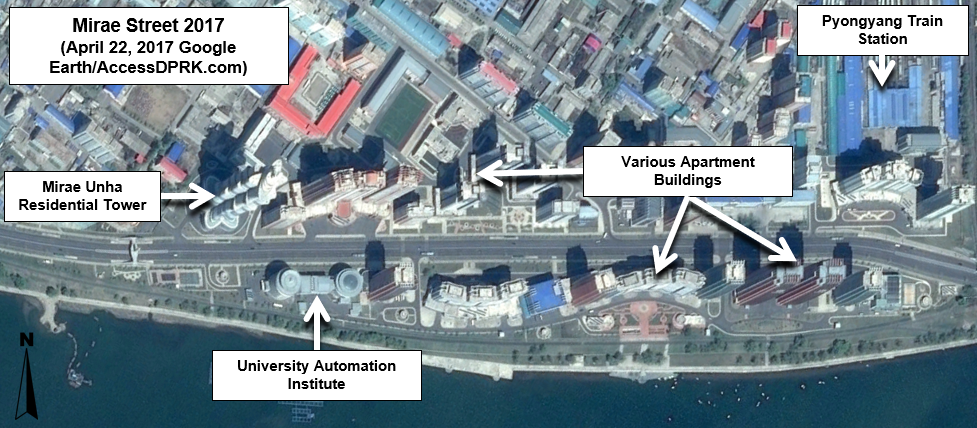
Public-private arrangements have been so successful that they have fueled an enormous construction boom. The skyline of Pyongyang would be unrecognizable to someone living even 15 years ago, and major cities around the country have benefited as well. Many in North Korea’s million-man army are used as laborers in these projects. While that isn’t anything new for North Korea, now specialist military carpenters and other skilled soldiers are paid a premium by the newly rich for their skills at constructing quality buildings and even creating home fixtures.
Marketization and culture
All of this more general economic activity has helped open the door to things that aren’t strictly a matter of finance or infrastructure. Personal freedoms, too, have begun to expand. Cell phones, now numbering over three million, not only facilitate trade, but have obviously had an impact on the personal lives of those who own them.
Prior to marketization and the ability for people to even have a cell phone, communication between average people was generally limited to speaking in person and writing letters. Few people even have landline phones as they require a substantial government approval process. Relationship opportunities were thus limited as well. Even today something we’d consider very trivial, like holding hands in public, is frowned upon. Dating, as we know it in the West, simply doesn’t exist and North Koreans remain painfully naïve when it comes to sex. Picking a wife or husband usually involved having the marriage arranged by family, or simply picking a mate based on their good songbun.
Now, however, armed with cell phones and disposable income, a small degree of liberality has set in. Young lovers can now find rooms to rent by the hour – usually in the home of a grandmother who is eager to earn a little extra money. She will often go for a walk or visit the local marketplace for a bit, while the young couple gets to know one another. Even more scandalous activities like prostitution, which was seen as part of the moral depravity of capitalist societies, is now exercised in public. There are even reports of police actually helping protect the women.
On less dramatic topics, the availability of consumer goods like electronics, and the willingness to break the law to watch pirated South Korean TV shows and American movies, has begun to create a population that expects to live a better life; one that includes leisure. Even though the national priority of leisure may seem to belong at the bottom of the list, considering malnutrition is still generally widespread and that thousands continue to languish behind the electrified fences of concentration camps, the government has taken to importing countless electronic items from China. North Korea is even producing their own cloned versions of iPads, Mac Computers, and the Windows Operating System. The government has also begun to build amusement parks and arcades.
Going back to the construction boom, a sort of semi-legitimate housing market has emerged as well. Private ownership of property isn’t possible in North Korea, but people are issued “residency certificates” that, for all practical purposes, are treated the same way a deed would be treated elsewhere. So, when someone makes enough money and they want to move, they simply sell the residency certificate and acquire a new one for their new home. This further weakens the state's control over the lives of the people.
In conclusion
Even in the most oppressive country on earth, where people literally don’t understand that there are different kinds of love (for true love is reserved only for the Kim family), or that using your talents and ingenuity to deal fairly with your fellow man is the basis of capitalism – despite these things, the human spirit endures. The desire for individuality and for forging your way is engrained in our very make-up, and no system of government or amount of repression can fully drive out the essence of liberty.
The determination of the people to live their own lives spurred on the marketization of the country. That, in turn, provided enough pressure to “encourage” the government to accept the markets, the slightly freer movement of people within the country, and provided the incentive needed to modernize and upgrade certain areas of the infrastructure (which had previously been kept limited and served as a means of defending against an invading army).
For those of us in the United States (and the rest of the world), it isn’t simply enough that we fight to be allowed to rent a room to a stranger or to be allowed to buy and sell online with a level of privacy. As North Korea shows, creating and forcing economic freedom from the bottom up forces governments to change and provides the environment needed for greater personal freedoms. However, the inverse is also true. When government seeks to limit either personal or economic freedom, it begins to impinge on the other liberties we have.
Things like privacy rights helps ensure a confident consumer; be they a consumer of Walmart or a consumer of government services. The protection of free speech enables concepts like Wikipedia to turn into a reality that can actually challenge authoritarian systems around the world. Defending free association and ending access barriers to technologies that were once inaccessible to the private sector, like the exploration of space, makes things like Google Earth and reusable space craft a reality. The benefits are endless.
If the people of North Korea can crack the heavy veil of 70 years of oppression and servitude, we can, and we must, do all that’s possible to prevent the erosion of the liberties we have enjoyed for over two centuries.
(This was originally presented to the Rutherford County Libertarian Party on Sept. 5, 2017.)
--Jacob Bogle, 9/3/2018
JacobBogle.com
Twitter.com/JacobBogle
Facebook.com/JacobBogle