Showing posts with label Punggye-ri. Show all posts

Nuclear Fallout Part II: the health consequences of Pyongyang's nuclear program

December 27, 2019 Add Comment

Pollution and health risks exists at every point along the nuclear weapons’ development chain, from the initial mining and milling operations to the enrichment process, and finally from testing nuclear devices. In this two-part article I will examine each of those areas and the health risks associated with them.

In this second part, I finish discussing the health consequences of North Korea’s nuclear program by examining issues related to their underground testing. (Part I can be read here.)

Testing

After producing the needed nuclear fuel and solving the other matters associated with creating a nuclear device, the next step is testing.

After decades of work the regime was able to test its first nuclear device in 2006. The underground test was carried out within Mount Mantap at the Punggye-ri nuclear test site. However, there is no such thing as a safe nuclear test, even when they’re underground. The original tunnel for the 2006 test was closed up shortly after the test as a result of radiation releases according to 38 North. Since 2006, five additional tests have been carried out in different tunnels. Further reportingindicates that another delayed leak was also detected as a result of post-tunneling activities in 2013.

Even under the best circumstances, underground nuclear testing still can release some radionuclides into the atmosphere. Less than optimal testing can pose a much greater radiation risk to those downwind of the test site. Initial radiation releases from a containment failure occur through “venting” but releases can continue for longer through “seeps”, where radiation finds its way out of the underground site through small fissures and openings in the overlying rock. Radioisotopes of xenon (such as 133Xe and 135Xe) are almost impossible to contain and can travel across the globe, as Canadian detectors picked them up after the very low-yield 2006 test.


Punggye-ri is in a mountainous area with little population but the main tunnel entrances are less than 2 miles away from the boundary of the Hwasong Concentration Camp. Due to the extreme human rights violations facing prisoners, we can’t hear their stories or send professionals over to determine how much radiation they have been exposed to. Residents within the larger area, however, have been able get their experiences to the broader world.

In 2017, South Korea reportedthat four defectors who lived in the area around Punggye-ri showed signs of radiation exposure. Defector Lee Jeong Hwa, who lived in Kilju County, said, "So many people died we began calling it 'ghost disease’…We thought we were dying because we were poor and we ate badly. Now we know it was the radiation." Unfortunately, the inability to do detailed testing on people still living in the area and gather more definitive evidence prevents us from knowing the full effects of the testing.

Negative health impacts from underground nuclear testing is easily supported by looking at the results of underground testing in the United States. According to the US National Cancer Institute, some 2,800 annual casesof thyroid cancer within the US can be attributed to the “underground era” of 1962-1992, when the United States (and the Soviet Union) was limited to testing nuclear devices underground by treaty. While North Korea has only had a limited number of tests, those tests have increased radiation levels for the region and caused an unknown level of damage to the population. Of particular concern are the 20,000 Hwasong prisoners, who are also suspected of being used as slave labor to help dig the tunnels used at Punggye-ri.

The stability of portions of Mount Mantap is also of concern after six tests, and surface changes as a result of ground shifting have been studied in detail. The first two (of four) tunnels are likely to be unusable for any future testing. Worries over accidental radiation releases from collapsing tunnels spurred China to install additional radiation detectors along their border with North Korea in 2017 and at a newly constructed border crossing in 2019.
The other two tunnels exist to the west and south and have not been used to-date. Their entrances were demolished in May 2018; however, questions remainabout the irreversibility of those closures.

Occasional rumors of a possible future above-ground test (for which there are very few potential testing sites) raises the stakes even more. Radiation would flood over Japan and would reverse decades of atmospheric radionuclide decline around the globe.

Conclusion

The known risks associated with the chemicals and processes involved in mining, milling, and enriching uranium, as well as in the production of other radioactive materials, supports the descriptions of illnesses as told by unrelated sources, each with first-hand knowledge of the locations discussed.

Despite the guarantees of the North Korean constitution and international law regarding the right to favorable working conditions and the right to pick one’s career (or to leave it), expert and defector testimonies, coupled with satellite imagery, paints a very different and dangerous story. It can be said that a major humanitarian and health crisis is brewing within North Korea as we know the substandard state of their nuclear program – not just in terms of technology but also safety.

Most of the facilities within Punggye-ri’s 17-kilometer-long compound still stand, waiting to be used again. Yongbyon continues to grow and thousands of additional scientists, laborers, and their families have been moved in under Kim Jong Un. The mines and milling plants still produce materials to be sent to enrichment facilities. And the regime keeps working on their abilities to deliver ballistic missiles to any part of the globe. It is clear that the sixty years of nuclear harm now affecting the tens of thousands of North Koreans who have worked to develop Pyongyang’s nuclear program over three generations of Kim will continue into the future, causing more harm, more sickness, and will likely require the efforts of multiple countries to finally resolve once the Kim Era is over.


I would like to thank my current Patreon supporters: Kbechs87, GreatPoppo, and Planefag.


Jacob Bogle, 12/26/2019

Patreon.com/accessdprk
JacobBogle.com
Facebook.com/accessdprk
Twitter.com/JacobBogle

Punggye-ri Nuclear Facilities Still Stand

September 03, 2019 Add Comment

North Korea tested their most powerful nuclear device on Sept. 3, 2017. The bomb was estimated to have had a yield of between 100 kt and 250 kt, which is the upper reach of the test mountain's ability to contain the explosion. In other words, a larger bomb could have destroyed the mountain (Mt. Mantap).

After the test, the world seemed to be bracing for a war between the United States and North Korea. What happened next made history. In November North Korea stopped every kind of test related to their WMD programs: ballistic missiles, nuclear, everything. The North also took the unprecedented step of blowing up the tunnels (also called portals) used to test their nuclear devices at Punggye-ri in May 2018.

While many hailed this decision, others pointed out that the much promoted "destruction" only destroyed the portal entrances. There's no evidence the vast tunnel system beneath Mt. Mantap was destroyed. This left open the opportunity for the site to be reclaimed once the small amount of debris was cleared out. According to a statement from the Institute for Science and International Security by David Albright:

"North Korea’s action is better than a freeze and represents a disabling of the test site. However, like many disabling steps, North Korea could likely resume testing at the site after some weeks or months of work. Although the main mountain is unlikely to be usable, other nearby mountains could be used. And two of the portals (numbers 3 and 4, using North Korean nomenclature) were apparently intact and usable for further nuclear explosions prior to the dismantling steps conducted."

Despite that warning, relations continued to thaw. And then on June 12, 2018, a sitting American president and a leader of North Korea met in person for the very first time. The Singapore Summit was short on details and formal disarmament agreements, but North Korea maintained its own nuclear and missile testing moratorium for a year. However, since Nov. 2018 (a year after tests stopped in 2017), the country has tested over a dozen short-range missiles during seven different launching events.
Additionally, after dismantling a test stand at the Sohae Satellite Launching Station in June 2018, the test stand was reconstructed in 2019. Oh, and let's not forget the continued production of uranium at the Pyongsan uranium milling plant.

So what do the resumption of missile testing and the reconstruction of weapon sites have to do with Punggye-ri?


This image shows the north portal as it was in 2015. All of the various buildings are standing and the site is operational.

The below image is after the May 2018 demolition. You can see that the portal area has been disturbed by the explosions and the support buildings are gone.


Free open-source satellite imagery from Google Earth shows that while some of the tunnel entrances were indeed destroyed, the entire rest of the nuclear complex is still standing. This strongly suggests that North Korea was never serious about engaging in any activities that would substantially or permanently disable their ability to develop and test nuclear weapons or long-range missiles. It also backs up what David Albright (and others) have said, North Korea could rather easily resume testing if they desired.

Punggye-ri is located in North Hamgyong Province and lies adjacent to the Hwasong concentration camp. (I raised concerns about prisoners being used for slave labor at the site back in 2017.)
Starting at the small village of Punggye-ri, the testing complex runs over 17 km north along a river valley that eventually leads to the base of Mt. Mantap, where the tunnels are and the testing occurs.


This series of images will take you from the tunnels (portals) and down along the valley until reaching the train station. They will show, without doubt, that other than the initial demolition of select facilities near the portals, the entire complex still stands.


As of March 2019, all of the sites within the northern administration area are still standing, including the checkpoint.


About 700 meters to the south of the northern administration area is a set of barracks. There hasn't been any change to them since the May 2018 "shutdown".

Further south is the second security gate. Maintaining these internal security points (which are north of the main entrance location) would not be necessary if the facility was permanently decommissioned.


Still moving south, 5.8 km away from the second gate, is another set of barracks and support buildings.


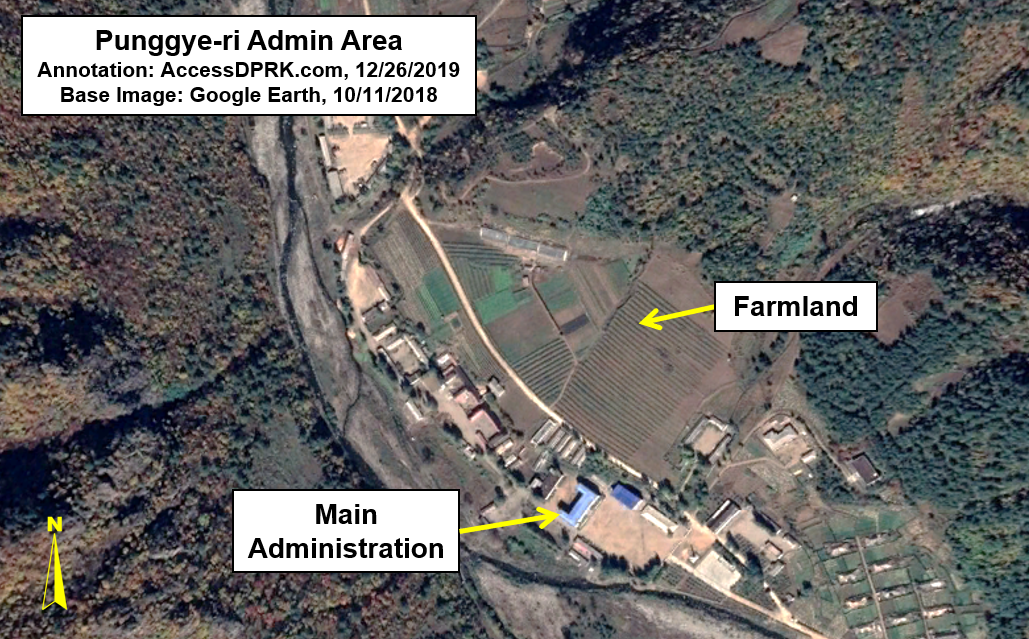
This southern area has barracks and a set of agricultural buildings. Portions of the valley are used to grow the crops eaten by the personnel stationed at Punggye-ri. Lush fields of various crops can be seen on an image dated October 11, 2018. Five months later and the fields are resting for winter and the buildings still stand as seen in the above image.


The southernmost part of the testing complex is the central administration area. It deals with logistics, supporting overall operations, and manages personnel housing. It, too, is fully intact.

Finally, there's the train station and main gate.


If the site had been permanently closed, it makes sense that the gate would remain to prevent people from walking into a dangerous area, however, when its existence is combined with the rest of Punggye-ri, it leaves little doubt as to its continued survival as a future nuclear testing site. Additionally, the train station hasn't been altered in any way. The civilian village of Punggye-ri only has a few hundred residents, the train station would only need to keep one of its two platforms to maintain domestic rail service.


The unchanged status of Punggye-ri has been further verified with newer imagery from DigitalGlobe as recently as July 2019 by 38 North. Two years on from their last test, the site's continued existence calls into question the wisdom of increasing funding by over 10% of the Inter-Korean Cooperation Fund, to hit a total budget of $1.18 billion. The fund's purpose is to help establish peace and grow economic ties between the two countries. However, North Korea has a history going back decades of defaulting on loans, stealing equipment, demanding even greater payments, and commandeering joint projects (like the industrial site at Kaesong.) They do this while surreptitiously continuing their weapons program and engaging in countless illicit acts to bypass sanctions and earn even more foreign currency.

Punggye-ri's ability to be quickly restored, the reconstruction of the Sohae missile launch site, the repeated missile tests resuming in 2018, and Pyongyang's massive infusion of cash into their conventional forces are all none-to-subtle hints that they will not stop being a threat, no matter how earnest the Moon and Trump administrations would like to make friends.

I would like to thank my Patreon supporters:  Kbechs87, GreatPoppo, and Planefag.

--Jacob Bogle, 9/3/2019
Patreon.com/accessdprk
www.JacobBogle.com
Facebook.com/JacobBogle
Twitter.com/JacobBogle

Possible NK Atmospheric Nuclear Test

December 12, 2017 Add Comment
North Korea is the only country to have tested nuclear weapons since 1998, when India and Pakistan both held their final underground tests, and all of North Korea's six nuclear tests have been carried out underground at the Punggye-ri Nuclear Test Site beneath Mantap Mountain (which is adjacent to the Hwasong Concentration Camp).

The firing of the Hwasong-15 Intercontinental Ballistic Missile (ICBM) on Nov. 28, 2017. Image from Rodong Sinmun.

Under Kim Jong Un, North Korea's nuclear and ballistic missile programs have become incredibly advanced and the speed of their accomplishments have often taken analysts by surprise. The development of these systems has occurred under the "two-track" or byungjin philosophy which seeks to develop the country's nuclear program and domestic economy in parallel. While their economy creeks along, it is becoming apparent that their nuclear and ballistic missile programs have been able to become largely self-sufficient and are produced with indigenous materials and technology.

The September 2017 nuclear test was their largest test by far with a yield estimated to have been between 100 and 250 kilotons, which places it several times larger than the atomic bombs dropped on Japan during World War II. Furthermore, it is possible that the tested device was a hydrogen bomb and that the warhead could have a variable yield, allowing North Korea to "dial" up or down the warhead's power.

On the ballistic front, their November 2017 test of the Hwasong-15 ICBM showed that they could theoretically hit any part of the United States (and a majority of the rest of the world). While questions remain about the missile's ability to survive reentry, there is no doubt that this is a huge step forward. Its size, range, and changes to the reentry vehicle over the Hwasong-14, all point to a program that is rapidly nearing completion.


At this point you may be asking what all of this has to do with the title? In October 2017, North Korea's Foreign Minister, Ri Yong Ho, said that Kim Jong Un was committed to testing a nuclear weapon in the atmosphere. And rumors of such a test have been heard prior to this statement, too. Atmospheric nuclear testing was last carried out in 1980, by China. The US, Soviet Union, and UK each ended their atmospheric testing in 1963 with the signing of the Partial Test Ban Treaty (PTBT).

North Korea's Exclusive Economic Zone (EEZ) in red, South Korea's in green. Data from Marine Regions.

The purpose of such a test would be, ostensibly, to prove their ability to attach a nuclear warhead to a missile and then to fire it off toward the sea and have it detonate - demonstrating they are indeed a fully capable nuclear weapons state. Any test would have to be carried out within the limits of North Korea's territorial waters, or at a maximum, its exclusive economic zone. Firing a nuclear missile outside of their EEZ would trigger a major world crisis the likes of which hasn't been seen since the Korean War.
Of course such a test (regardless of whether or not it occurred within their own territory) would likely permanently alter regional relations, could easily drive China out of whatever remaining alliance with the DPRK they have, spur Japan into full-on re-militarization, and could even lead to an attack on the North by either South Korea or the US. It's also highly unlikely that the US would sit idly by and watch as North Korea mounted a nuke onto a missile and fire it. So the chances of an atmospheric test are rather low in my estimation.

Beyond the geopolitical implications, the environmental impact would also undo progress toward addressing the radioactive genie that was released after the Trinity Test in 1945.

Atmospheric testing releases huge amounts of radiation into the environment. A 2013 study that looked at atmospheric radiocarbon showed that 2010 levels were at their lowest since the late 1950s, with the PTBT being the seminal moment when radiocarbon rates began to sharply decline.

Chart showing the percentage of Carbon-14 in the atmosphere from 1950-2010. (Source: Atmospheric Radiocarbon for the Period 1950–2010)

Above ground tests (atmospheric or otherwise) also release large amounts of radioactive Iodine, Strontium, Uranium (obviously), Caesium, Xenon, and other radionuclides. The half-lives of these materials range from a few hours (as in the case of Xenon) to hundreds of years and longer. Above ground testing can throw radioactive particles as high as 50 miles into the atmosphere where they will then be carried by the winds for many miles (with minute amounts traveling the globe) until they eventually settle back down to the ground and sea where they will continue to release radiation for years to come. Local radioactive fallout can extend in a plum easily over 100 miles long, placing each regional nation at risk of receiving fallout depending on the specifics of the test and weather conditions at the time.


All of these risks - the overt threats to South Korea, Japan, and the US, the dangers of spreading fallout over Chinese or Russian territory, etc. - are why I hold strong doubts that North Korea would ever conduct an above ground test. However, while thinking on the subject, I also considered what ground locations may exist that North Korea could use to conduct an old-school non-atmospheric above ground test.

Analysts have determined that the Punggye-ri test site may have experienced tremendous damage, particularly as a result of the latest test. While activity at other tunnels around the site has been seen, continued nuclear testing greatly raises the risk of a major collapse and release of radioactive materials. So the next best thing may be an above ground test.

Possible suitable locations for an above ground nuclear test.

I searched for the criterion of a 12-mile diameter circle (an "exclusion zone") that didn't overlap with any populated areas or, in the case of islands, that didn't overlap another island group or cross onto the mainland, and that wasn't too close to China or Russia. I was able to locate four such places. Three of which are islands/group of islets, and one is the Punggye-ri site itself. Punggye-ri is isolated enough that there are no cities or towns within the 12-mile circle and the nearby concentration camp (with its thousands of prisoners) would partially be protected from the immediate radioactive fallout effects by the mountain itself.

The other three sites are far enough away from the coast and any populated islands that the civilian population would be safe from the actual blast of a nuclear device, so long as it wasn't too large. These sites also have the added benefit of being within North Korea's internationally accepted territorial claims, which would give Pyongyang some degree of diplomatic cover.

We can only wait and see if Kim Jong Un thinks it's worthwhile to set off a nuclear device in the open, be it fired from a missile into the sea, set off on an island, or even detonated in the ocean from a barge, but one thing we can be sure of is now that he has a bomb and a missile, he won't be giving them up for cheap.


--Jacob Bogle, 12/12/2017
www.JacobBogle.com
Facebook.com/JacobBogle
Twitter.com/JacobBogle


Additional Reading
1. Nuclear Weapons Testing and Environmental Consequences: A Global Perspective, Remus Prăvălie, February 2014 (Ambio, A Journal of the Human Environment)