Showing posts with label Kaesong. Show all posts

Rockets and Runways

January 30, 2018 Add Comment
Kim Jong Un observing the Sept. 15, 2017 launch of a Hwasong-12 ICBM at the Pyongyang-Sunan International Airport. (Source: KCNA)


Kim Jong Un is well on his way to becoming the most prolific builder since his grandfather, Kim Il Sung. There are the new roads, the billions spent on construction projects in Pyongyang and in other major cities, modernizing airports and constructing new ones, and much more. Kim Jong Un has been busy as he enters his seventh year in power.

Those further changes to North Korea's military airbases and other runways, as well as the stunning advancement of their ballistic missile program makes it necessary for me to write, once more, about the ever-progressing nature of North Korea's military. There are three main areas of focus for this post. The first is the construction of multiple new aircraft parking revetments at new and older emergency runways. The second is the construction of more emergency runways. And the third deals with the possibility of the merging of North Korea's major airbases and ICBM program.


North Korea has 111 airports, airbases, heliports, emergency highway runways, and other landing strips. Particularly since 2016, nearly all of their emergency highway runways (straight sections of road that have been widened for use by aircraft in the event of a war) have had aircraft parking revetments constructed to augment each site. Additional basic runways have also had revetments constructed. In all, 15 airfields have had new revetments constructed. The number of revetments varies between one and four (most have three), but there is a grand total of 39 individual revetments which could support a combined 75 aircraft (at least) depending on type and parking arrangement.

It's important to note that not all of the satellite imagery of all of the different air facilities in North Korea has been updated to include either 2016 or 2017 imagery, so it's possible there are other sites that have had revetments constructed. I just can't yet see them.

Here are some examples of these sites. Click on any image to see an enlarged view.


Since my 2015 article on the North Korean Air Force and the changes that have happened under Kim Jong Un to the physical infrastructure of the Air Force and general aviation, at least three additional runways have been constructed.

Changdo, Kangwon Province (38.67993°, 127.72681°)


This runway is also approx. 3 miles (4.8 km) north of a military training base that underwent fairly substantial expansion in 2013.

Chongjin, North Hamgyong Province (41.80234°, 129.85480°)

This small auxiliary runway was constructed in early 2016.


Sunchon, South Pyongan Province (39.44058°, 126.03576°)

This runway is being constructed across from the large Sunchon Cement Factory. Curtis Melvin at North Korean Economy Watch believes that this will be a new 'executive' runway for use by Kim Jong Un and other high ranking officials. What makes it odd, in my mind, is the fact there are two large military airbases (and a helicopter base) within 12 miles (19 km) of this new runway - after all Sunchon is an important industrial city.
Perhaps the 30 minute drive was a bit too much for the Supreme Leader.


North Korea has a history of testing missiles from their airports, particularly at Wonsan (Kalama) and Pyongyang International. During the modernization and expansion of Wonsan, an observation facility was constructed as well as two concrete launch pads on the beach. And as you can see in the opening image of this article, Kim Jong Un observed the test of a Hwasong-12 ICBM from Pyongyang International. But unlike Wonsan, the Pyongyang launch was carried out on the bare ground.

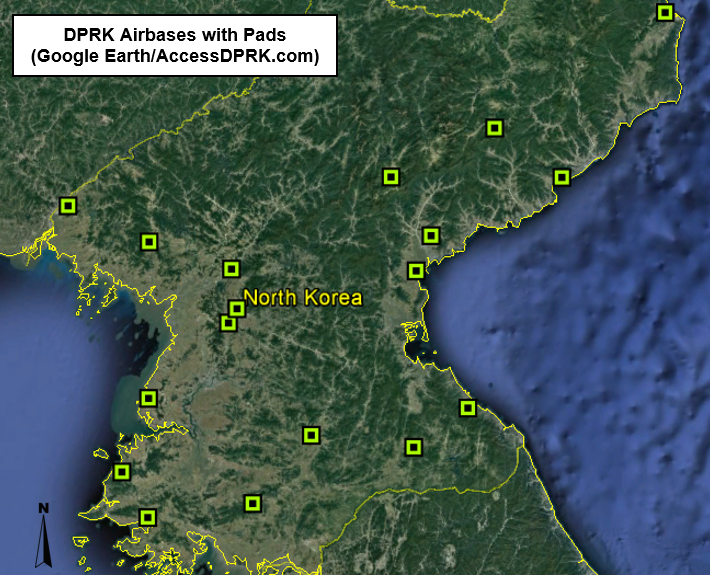
Along the line of launch pads, there has been a curious development at 19 of North Korea's major air facilities. Starting in 2015 and extending into 2016 (such a busy year), twin squares of concrete began to pop up at these airbases. Unlike the small launch pads seen at Wonsan or other sites, which are approx. 60 x 80 feet (18 x 24 meters), these new pads are each roughly 165 x 140 feet (50 x 43 meters). All but two airbases have two of these pads, one at each end and directly in line with the runway's path, but not connected to it. The other two just have a single pad. Most are made of concrete, but a few are simply areas of cleared land and compacted dirt.


My initial thought was that these were helipads, but they're much larger than most helipads in the country. Additionally, these are military bases and space already exists for helicopters. Furthermore, Pukchang Airbase (near Sunchon) has an adjacent helibase with dozens of helicopters stationed there, yet the main airbase also has these new pads. Use of these sites for helicopters is also lessened because the pads aren't directly connected to the runway and are separated from them by around 170 feet (51 m).

I am not an aviation expert, but I have explored the globe via Google Earth (and been to a few airports) and I have yet to see this layout anywhere else. My second thought then became, what if these are actually meant to allow rapid deployment of various missile systems? (Their size would accommodate everything in North Korea's arsenal.) I have asked for the input of others but wasn't able to get much more than "that's plausible", with no other firm alternative explanations. So perhaps North Korea now has 36 new ICBM launching sites, or maybe it's something else entirely. The fact these things popped up across the country, basically overnight, are fairly uniform in size, and are only located at major military sites, impels me to at least bring attention to them.


These two images shows the pad area at Kaechon Airbase before and after construction.


This next set of images is just a sample of different bases with the pads.


Here is the list of coordinates for each of the airbases with these pads.
Changjin: 40.36680°, 127.26304°
Hwangju: 38.65468°, 125.78629°
Hyon-ni: 38.61354°, 127.45410°
Iwon: 40.36044°, 128.71995°
Kaechon: 39.76226°, 125.91326°  (only has one pad)
Koksan: 38.68810°, 126.60147°
Kuum-ni: 38.86713°, 127.90625°
Kwail: 38.42360°, 125.02213°
Nuchon-ni: 38.23767°, 126.11891°
Onchon: 38.90914°, 125.23311°
Orang: 41.43005°, 129.64906°
Panghyon: 39.92883°, 125.20714° (Panghyon is near the site of the July 4, 2017 ICBM test)
Pukchang: 39.50491°, 125.96567°
Sondok: 39.75929°, 127.47621° (only has one pad)
Sunchon: 39.41134°, 125.89543°
Taetan: 38.13016°, 125.24616°
Toksan: 39.98743°, 127.60276°
Uiju: 40.15111°, 124.49965°


My ego isn't so fragile that I can't handle correction. If you think (or know) I have misidentified these sites or can offer a plausible alternative, please let me know!


--Jacob Bogle, 1/30/2018
www.JacobBogle.com
Facebook.com/JacobBogle
Twitter.com/JacobBogle

New launching/landing sites constructed?

January 06, 2017 Add Comment
UPDATE: These have been confirmed as emergency parking positions for jets, since highways can be used as auxiliary airfields (and North Korea does have at least 14 official "emergency highway strips").


On the heels of Kim Jong-un suggesting that the country is very close to testing another ICBM, I've discovered three sites that could be used as dedicated mobile-missile-launcher pads.

These sites were constructed in 2016 and have the same general design.

The first and largest is near Kaesong and lies less than 10 miles (16 km) from the Demilitarized Zone with South Korea.

Located adjacent to the Pyongyang-Kaesong Highway, by the village of Haeson-ri, this site was under construction in March and had been completed by October 2016.

Each pad is 45 feet (14 meters) wide and the straight portion is 175 feet (53 meters) long. The area around it also contains numerous bunkers and tunnels.

The second site is in Pyongsong, South Pyongan Province, which is 21 miles (34 km) north-northeast of the center of Pyongyang.


Just like the Kaesong site, this one is located adjacent to a main highway. In this case, National Highway 65. The area also has a high concentration of HARTS (Hardened ARTillery Sites), which are marked by the red dots. Several additional military facilities are also nearby.


Lastly, the third site is similar in its size and the fact it's right off a highway, but its design is different. The primary difference is a lack of a central berm. This site is located near Sukchon, also on South Pyongan.


If these are indeed dedicated pads for launching missiles, it would be in line with North Korea's continued modernization and expansion of their offensive capabilities.

________________________________________________________________________________________
I'd like to make a quick note about the #AccessDPRK Mapping Project. Across North Korea, I have located 9,500 military related places. I have finished the primary mapping process and am now working on incorporating the work of two others into a main and comprehensive single file. After that, the entire body of work will be published.

--Jacob Bogle 1/6/2017
www.JacobBogle.com
Facebook.com/JacobBogle
Twitter.com/JacobBogle
The Lost History of Korea

February 20, 2016 Add Comment
(UPDATED Feb. 9, 2017)

This blog is three years old today! (OK, four years on Feb. 20, 2017)

When I started this mapping project four years ago, I had no idea how intensive of an effort it would become, nor did I realize there was so much ancient Korean history north of the DMZ just waiting to be mapped. So to celebrate this anniversary, I'd like to share with you some of the ancient sites and fortresses I have found in North Korea. I was able to map 213 locations (including additional wall segments of otherwise known sites). Of these sites, I can't find any information on at least 2/3rds of them. I have found several tombs as well, but those aren't part of this data release because they're part of the larger "burial mounds" section of the main mapping file and will be released in due time. Those 213 sites are in addition to the 113 sites found by Curtis Melvin's "North Korea Uncovered" project. Many of them, likewise, aren't identified other than their location.

Using satellites to search for archaeological sites was pioneered by Dr. Sarah Parcak, particularly in Egypt. And while the purpose of #AccessDPRK wasn't just to find ancient sites, having literally looked at every square mile of North Korea, I have been able to help fill in a lot of holes in this part of the world and I look forward to the experts providing the details one day.

You can download the full Google Earth file with all 336 historic North Korean sites at the bottom of this article. It also includes 56 ancient forts and city walls in South Korea!
(This map shows you the general locations of all 336 archaeological sites.

When most people think of Korean history, they focus on the Korean War, or perhaps, look as far back as the occupation by Japan which began in 1910. However, just like their neighbors China and Japan, Korea's known history dates back thousands of years. Unfortunately, that relatively modern event of Korea's division and war did mean that whatever history that had touched the northern half of Korea was, in many meaningful ways, lost to the West.

Undoubtedly there are scholars both north and south that know about most of these places, if not all of them, but for those of us without advanced degrees in Korean archaeology, many of the places I have found are enigmas.

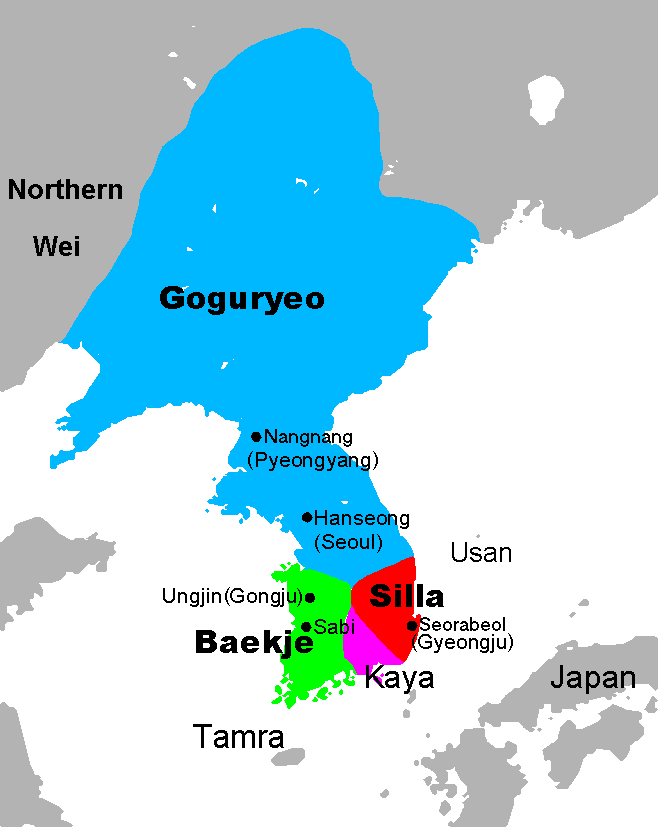
First, I would like to give you a quick primer on pre-1900 Korean history starting with the Three Kingdoms Period. The Three Kingdoms Period, which began in 57 BC, was when the Korean Peninsula, and part of what is now China and Russia, was dominated by three kingdoms, the largest of which was Goguryeo (and it encompassed all of modern North Korea). The other two were Silla and Baekje, along with a few small tributary states.


The period ended when Silla, aligned with China, conquered Goguryeo in 668 AD. During those turbulent years, a "great wall" of Goguryeo was constructed that extended from Bohai Bay, moving northeast 300 miles to modern-day Nog'an County in China. It is important to note that for centuries, the history of Korea was strongly influenced by the machinations of China, and at times, the nominally independent Korean kingdoms were still client states of China. What followed the end of the Three Kingdoms Period was a two-state system, Balhae in the north and Silla in the south. 

Both states existed until the unification of Korea under the Goryeo dynasty in 936 AD. In the 11th century, the Goryeo built a second "great wall" (both of which are called Cheolli Jangseong or Thousand Li Wall). Like its northern predecessor, it too stretched for 300 miles, except its course was more or less west to east and was entirely within the territory of today's North Korea. 

Red: Goguryeo wall Blue: Goryeo wall

The Kingdom of Goryeo thrived until the Mongol invasions in the 13th century. Finally, between 1388 and 1392, a civil war led to the death of the Goryeo ruling families and its throne was usurped by General Yi Seong-gye forming the Kingdom of Joseon which lasted until 1910. I would like to point out that Korea was a unified peninsula for 1,009 years (which ended in 1945 with the division of Korea). The artificial and forced division that affects North and South Korea still stings and both sides want eventual reunification; they're the same people with the same language, the same shared history, and in many respects, still retain the same culture

During all of this history, various defensive walls, forts, and fortified settlements were constructed all over Korea. There were likely fortified settlements built prior to the Three Kingdoms Period as well, but I can't find any information about them. Here's the official list of the "National Treasures of North Korea".

While these places are in North Korea, I have to stress that these sites are part of the history of all Koreans, and indeed, the world. Korea's distant civilizations and their advances mirror the great leaps in China, the Middle East, and Europe and should be preserved. Perhaps in the future, as we hope for bettering relations between the DPRK and the rest of the world, and even hope for unification, these sites will become known and fully researched so that another chapter of human history can finally be completed.

North Pyongan Province has the most sites with 98. I have marked 71 and Melvin marked 27.

(The various blue lines map out the different defensive walls.) 

Excluding fortress walls, I've mapped out around 50 miles of long defensive walls. These walls are roughly broken up into 3 main lines. Two walls run parallel to each other in the north and a third is located farther south near the border with S. Pyongan Province.

These walls follow the contours and peaks of mountain ranges.


There are several fortresses and walled cities in N. Pyongan. The most impressive is the ancient city of Yongbyon. That name may sound familiar to you because the Yongbyon Nuclear Facility is located nearby. National Treasure number's 46-50 are located here.

(Yongbyon Walled City. Blue lines/markers are mine, yellow are Melvin's.)

The single densest archaeological region is near the city of Sinuiju.


With tensions currently very high between North and South Korea, and South Korea having recently closed the Kaesong Industrial Region (which is a joint-venture physically located in North Korea), I'd like to move south to the city of Kaesong. Kaesong has a very long history and served as the capital of Goryeo between 919-1394.


Many historic sites in North Korea are at risk of being destroyed, particularly those in urban areas. Portions of Kaesong's old wall (Nat'l Treasure Nos. 129/130) have been destroyed due to mining.


Similarly, the Kyongsong walled city (National Treasure No. 118), is at risk. Three roads have cut through the wall and a sizable portion of the southern wall has completely disappeared as houses have been built there.


Near the city of Munchon, Kangwon Province, there is a hillfort and a long wall running west.


There are 24 sites in North Hamgyong Province and I was a bit surprised by how many there are. The northernmost portions of Korea have long been given the lowest priority, both during the imperial era and during the DPRK regime. Although, I suppose if you do treat a region poorly, you might want to build some forts to keep the peace.

The northern part of the valley where the town of Komusan sits, splits into two smaller valleys. Each one holds a fortress (less than 3 miles apart). One of the forts has had its northern wall demolished for a rail line to go through and the other fort has a lot of damage from centuries of erosion.


One of the most interesting sites is actually located in the Hoeryong Concentration Camp (Camp 22). The small adjacent village is called Haengyong and so I have dubbed it Haengyong Fortress. The site is where the camp administration buildings are located.


Moving on to cultural sites, located throughout the country are small temples and shrines. These are the remnants of a former deeply religious civilization. During the establishment and consolidation of North Korea's atheistic regime (unless you count their personality cult), Kim Il Sung had many places of worship destroyed. Fewer than 300 remain and the majority of those have been abandoned; some are still "active" as cultural relics.

Here are two typical sites. Both are in North Hwanghae Province and are nestled in the mountains away from populated areas (which might explain why they haven't been demolished).


The last place I want to show you is Kyongsong Hyanggyo. Located half a mile from the city walls of Kyongsong, the site is an old civil school. These were part of a system similar to the Chinese imperial examination system. These schools were where members of the Yangban (elite class) would go to become civil servants and bureaucrats. Various schools were created between 918 and 1392, and 1392 to 1897.

According to older imagery, the main building was damaged and then reconstructed around 2009/2010.

All 392 sites mapped in Korea. 336 for the North and 56 for the South.


To access all 392 ancient sites in Korea, you can either visit my file archive here and click the download button for "Koreas Ancient History_Final_2-9-17.kmz" or download it directly by clicking this link. To view the places you must have Google Earth.

The KMZ files are hosted on my Google Site https://sites.google.com/site/mymappingprojects/access-north-korea


--Jacob Bogle, 2/20/16 (updated 2/9/17)
www.JacobBogle.com
Facebook.com/JacobBogle
Twitter.com/JacobBogle
You can use the hashtag #AccessDPRK when discussing on social media.

North Korea: 2013 in Review

January 17, 2014 Add Comment
The year 2013 has been a busy one for we DPRK watchers. Lest we forget, here is a list of all things North Korea, both important and not so important.

2013 Crisis


2013 had barely begun when the provocations started pouring out of North Korea. On Jan. 22, the UN Security Council passed Resolution 2087 which condemned the North's launch of their "satellite" back in Dec. 2012. In response, the North announced plans to conduct further nuclear tests (its last one was in 2009) and rocket launches. They also called America "the sworn enemy of the Korean people". Usually, the threats and bluster made by the North tends to be empty, and although threats are taken seriously there is often an underlying mood of "yeah, yeah, calm down kid". This time they weren't joking.

On Feb. 12, they conducted an underground nuclear test which was by far the largest test they had ever done with a yield somewhere between 6 and 8 kilotons. Although it was small compared to international standards (the 1945 Trinity Test by the U.S. came in at 20 kt), it was a clear sign that they had advanced their capabilities (the 2009 test was a mere 2.5 kt) and that they were serious about developing an operational nuclear arsenal.

In March, the U.S. and South Korea (ROK) began preparations for "Foal Eagle" which is an annual joint-military training exercise and dates back to 1997. It is one of the largest (if not the largest) annual military exercises in the world and in 2013 more than 210,000 troops participated (only 10,000 were American soldiers). By March 13, in response to the exercise, the DPRK announced it would withdraw from the 1953 Armistice and all non-aggression pacts with the ROK (which has happened 6 times) and they cut off the direct Seoul-Pyongyang hotline. The North went further and stated that the next action they would take would be to actually attack the South and the United States.

Over the course of March tensions continued to climb. The U.S. sent B-52 bombers (nuclear capable) to patrol the South, set up additional Ground-Based Interceptor missiles in Alaska to protect the U.S. from any potential nuclear or other ballistic attack from the North, and deployed fighter jets and other defense systems. Japan also boosted their defensive position by deploying additional warships to the region. On March 20, banks and TV stations in South Korea were hit with a cyber attack linked to the North.

April saw the Kaeson Industrial Region closed. The region had served as an important symbolic joint-industrial facility between North and South, and an important source of hard currency for the North. Construction began in 2003 and cost billions of dollars to build, mostly financed by South Korean companies and the government. The purpose was to foster relations between the two countries and to benefit them both financially through light industrial activity. On April 8, the North recalled their 53,000 workers. Several hundred South Korean employees stayed at the complex and were subsequently cut off from food and aid, effectively serving as prisoners. The region remained closed until mid-September and the closure resulted in a loss of $944 million.

More importantly in April, the North announced that it would restart operations at the Yongbyon Nuclear Center which had been closed since 2007. The facility is crucial to the North's production of plutonium and thus their nuclear weapons program. By June, new satellite pictures showed the cooling tower had been rebuilt and pictures released on Aug. 31 showed the facility operating. During April the North also moved an intermediate-range ballistic missile platform to the east coast (with Japan being their nearest east coast neighbor) and the DPRK warned that certain countries with embassies in the North should evacuate their staff, including the U.K, Russia, and Sweden.

After several other weapons movements (on both sides), the North's fueling of their missiles, a dedicated war game by the U.S. to determine how easy/difficult it would be to secure the North's nuclear stockpiles (result: 90,000 troops and 59 days), the month ended with some additional bluster but most tellingly, the North agreed to re-enter into dialogue.

On May 6, the North withdrew two Musudan missiles from their launch sites, however, between May 18 and 20, they launched a total of six missiles into the Sea of Japan. May also saw several of China's largest banks putting an end to doing business with North Korea which was a significant step since China has usually turned a blind eye to the North's provocations.

At the beginning of June, North Korea rejected China's request that it halt any further nuclear tests, but on June 16, the DPRK government proposed direct talks with the United States to ease tensions. For the rest of the year things slowly began to cool down and saw North Korea, China, and Russia all proposing a resumption of the Six Party Talks. The Seoul-Pyongyang hotline was restored, both sides agree to re-open Kaeson and things returned to the schizophrenic "normal" that is so common on the Korean Peninsula.

However, there were still occasional threats, refusals to sign non-aggression pacts, and more threats; and this will likely continue for a very long time. 

Cargo Ship Seizure


North Korea has maintained a fairly healthy international arms trade for decades, yet as time goes by and international sanctions pile up, it is becoming ever increasingly more difficult for them to carry out their activities. The 509-foot long North Korean cargo ship Chong Chon Gang had been traveling in and out of the Panamanian area between April and July. In July, the ship was flagged for inspection, in part, because they had stopped signaling their location (which ships are required to do for navigation safety purposes). On July 15, Panamanian authorities seized the vessel and began searching it. They found 10,000 tons of Cuban sugar which was lying on top of undeclared cargo. That cargo included 240 tons of Cuban made weapons, two MiG-21 fighters in working condition, radar & control systems for missile launchers, 15 aircraft engines, 12 motors, and a quantity of ammunition. 

The official line from Cuban authorities was that the equipment was being sent to North Korea for repair (there is precedent for this so they could have been telling the truth). Of the 35 crew members, 33 were arrested for arms trafficking - the captain attempted suicide. The majority of the crew were finally released back to North Korea in November.
  

Kenneth Bae and Merrill Newman


From 1977 to 1983 the DPRK kidnapped dozens of Japanese citizens, they have also kidnapped South Korean actresses, producers, and other people from various countries (westerners were mostly kidnapped to work at the Foreign Language Office). I say that to impress upon you that the North Korean government has had no problem stealing people. In other cases, such as Kenneth Bae and Merrill Newman, the situation wasn't about making movies for Kim Jong-il, or the need for translators.

     Kenneth Bae is a Korean-American who has traveled to North Korea several times on business grounds. However, he has also been known to aid Christian groups in either spreading the Gospel or to assist them in getting people out of the country (both activities are strictly forbidden). On Nov. 3, 2012 Bae was visiting the Rason Special Economic District with five Europeans when he was arrested, it is claimed, for carrying a thumb drive filled with pictures of starving children, of conducting a smear campaign against the government, and of planning to toppled the DPRK government in collusion with the U.S., South Korea, and interestingly, China.

Bae was tried, convicted, and sentenced to 15 years of hard labor. In July 2013, after being sent to a prison camp, he became severely ill and has been detained in a prison hospital since he can no longer take part in manual labor. Because the United States does not have diplomatic relations with the DPRK, all diplomatic matters are handled by the United States' protecting power, Sweden. And due to this it becomes increasingly difficult to ensure his release. Bae's imprisonment has also been a point of irritation for Dennis Rodman thanks to his "friend for life", Kim Jong-un.

     Merrill Newman is an 85 year old Korean War veteran from the United States. During the war he was a member of the United Nations Partisan Infantry (also known as the "White Tigers") and engaged in guerrilla type activities as well as training anti-communist insurgents. In October 2013, Newman traveled to North Korea, something many veterans have done before, for a nine-day trip. At the end of the trip, on Oct. 26, Newman boarded an Air Koryo plane, but just prior to takeoff he was escorted off the plane and arrested.

Although word of his detainment quickly reached the U.S. embassy in Beijing via one of his travelling companions, North Korea did not acknowledge his arrest until late November. Then, on Nov. 29, the Korean Central News Agency (KCNA) released a video of Newman reading from a prepared document in which he "confessed" and apologized to a wide array of war crimes. It was also alleged that he had, during his visit, been in possession of forbidden and subversive items. He was finally released on Dec. 7, thanks in part to our friends the Swedes.

Generally speaking, so long as you follow the rules during a trip to North Korea you aren't likely to be arrested, detained, or otherwise harassed. However, people who are of South Korean origin, who fought during the Korean War, or whose family had fled the North during the war are more likely to be targeted. Kenneth Bae was born in South Korea and he was also a part of a Christian organization (Christians are particularly singled out for persecution) and, there is a chance he really was engaged in illegal activities. Of course, what the North considered illegal most of the world calls fundamental human rights. Bae could end up being released due to his health (it wouldn't look good if he died) but it's just as likely he will spend years more in prison.

In Merrill Newman's case, he was part of hostilities during the war (a war which technically is still ongoing), and his name, along with the names of thousands of others, were known to DPRK authorities before the 1953 Armistice was even signed. It is likely they singled him out not to capture or to kill, but to be used in domestic propaganda and then released, which is what happened. The valiant North Korean soldiers had finally caught an imperialist invader and forced him to confess to all the things the North routinely accuses the west of doing.

Anyone interested in travelling to North Korea, especially if you're an American, needs to be aware of the rules. If the North Korean government allows you to visit it's a good bet they have checked out your background and they will use the several sanctioned travel agencies to assist in determining your history, and thus your likely hidden agenda for going to the country. Carrying thumb drives, non-DPRK newspapers & books, Bibles, CDs, DVDs, U.S. currency, are all no-noes. Photography is controlled and if you tick off your minders you will either have your camera run over by the bus or confiscated, be immediately kicked out of the country, or if they're in the mood, you'll be charged with crimes against the state - something you really don't want to have happen. Here is an interesting & lighthearted article on being a tourist "20 Things I Learned While I Was in North Korea".

Jang Sung-taek


As I discussed earlier, Jang Sung-taek, Kim Jong-un's uncle, was executed on Dec. 13 for crimes against the state. Among the charges were: attempting to overthrow the government, collapse the economy, and degrade the cult of personality. His death was the highest level execution - and most public - since the time of Kim Il-sung. Jang's associates were also rounded up, including hundreds of family members (regardless of their actual guilt or complicity) and were either killed or sent off to concentration camps. These events are connected to a wider series of purges which Kim Jong-un has conducted ever since coming to power in 2011, all in an attempt to solidify his own absolute power. He was executed by firing squad.

His case reminds me of the arrest & execution of Pak Hon-yong in 1956. Pak was accused of trying to overthrow the government, of embezzling money (870,000 won as well as gold), and he held incredibly high office right up until the moment he was arrested. In reality, his real crime seems to have been questioning the power of Kim Il-sung.

Attack Notice


The year would not be complete without an obligatory warning to strike without warning. One Dec. 19, the North sent a fax to their southern counterparts warning them that they would hit the South with a "merciless strike without warning." These warnings are actually very common and their content from year-to-year doesn't change much, same for the medium through which they are sent. The purpose of these "surprise warnings" is up for debate, but the rationale behind the North's activities is about as clear as mud. On the one hand, constant warnings and even the occasional real attack has, at least for the past 30 years or so, led the South and international community to come to the bargaining table and allowed the North to elicit aid (food, fuel, cash, etc.). On the other, the North knows full well that it hasn't a chance of winning a true war, yet they are constantly drilling into the minds of their own people that war is always just around the corner and so it can serve as a means of propaganda and stress relief - as well as serving to keep the South in a constant (albeit just below the surface) state of anxiety, which can be thought of as a mild punishment for whatever sins the South had done that week. 

In Film

And now time for Hollywood. Apparently, North Korea has finally entered into public consciousness and because of that, the hermit kingdom known for its isolation has made a big splash on the big screen.


Olympus Has Fallen, featuring Gerard Butler and Aaron Eckhart, hearkens back to the 1968 Blue House raid in South Korea except this time the target is the White House. In the movie, North Korean assassins have infiltrated the South Korean president's protection unit. During an official ROK visit to the White House, these agents show their true colors and, in conjunction with a "sleeper cell" already in DC, overrun the White House and hold the U.S. president hostage. The goal? To use a top secret U.S. program to detonate our entire stock of nuclear weapons - irradiating the whole country. Thankfully, at the very last moment we're all saved.

The DPRK has a long history of assassination attempts against their southern brethren. Not only did they try to over take the ROK's executive mansion in 1968, they set off a bomb during an official ROK visit to Burma in 1983 which killed 21 people. North Korea maintains 150,000-200,000 special forces personnel and they truly are a force to reckon with. There is little doubt that they have at least considered such an attack on the U.S.

World War Z, is Brad Pitt's zombie apocalypse movie, and while the DPRK did not play a starring role in the film they were mentioned. North Korea was one of the few countries in the world which did not fall due to the zombie plague. Their defense? Since zombification was caused via biting, Kim Jong-un ordered that all of North Korea's 25 million citizens have their teeth removed; a feat accomplished in a matter of days (and according to the related book, they fled underground into the North's myriad of underground bunkers).

Next comes G.I. Joe: Retaliation. In this film, the "Joe's" infiltrate one of the North's many prisons to find an informant and bring him back to the U.S. Later on, the evil Zartan calls world leaders to a conference where he threatens the planet with destruction based on a new weapon. He says that the weapon could destroy each of the countries 14 times, but in the case of North Korea - 15 times (as, presumably. Kim Jong-un gives a "why pick on me?" look).

...and let's not forget Red Dawn from 2012 (it came out in November, so close enough). This remake of the 1984 cult classic was one of my favorite movies of the year. Unlike the Soviet terror in the original, the 2012 version features the DPRK (with help from the Russians, those bastards) unleashing a new, very high tech weapon - an EMP device. The lead character, played by Chris Hemsworth, leads an army of local youths in a battle to rid the American northwest of the surprisingly well fed Korean invaders. While the film's plot is unlikely, the threat of a surprise attack from the DPRK is not.


--Jacob Bogle, 1/17/2014
www.JacobBogle.com
Facebook.com/JacobBogle
Twitter.com/JacobBogle