Showing posts with label prison. Show all posts

Chongjin Prison Camp Update

December 06, 2019 Add Comment

Chongjin Prison, officially known as Kwan-li-so No. 25, is a North Korea prison near the city of Chongjin. Unlike sprawling camps like Hwasong or Kaechon, which occupy many square miles of territory, Chongjin is relatively compact, with prisoner housing and forced labor facilities all within a single walled compound. The one exception being an agricultural area that is surrounded by a fence.


Chongjin has undergone various changes over the years, one of largest being an expansion of the outer perimeter in 2010, and then the addition of a mining site in 2014. The most recent change is within the light industrial section of the prison.


All North Korean prisons use forced labor to engage in a range of activities from agriculture and light industry to mining and sewing clothes and uniforms. At Chongjin, its 3,000 prisoners must engage in agriculture, livestock activities, mining, and light industry. However, major changes to one of the factory buildings has been ongoing this year.

The factory building in question is approx. 185 feet by 105 feet in size. Its initial demolition had begun by February 2019 and only the basic framing of the building remained by March 15. An apparent partial roof section was placed on the structure by April 5. Little else has happened as of July 22, 2019 which is the latest Google Earth image available. As of that time, the factory sits as just a shell and is missing the vast majority of its roof.

In this February 2019 image, you can see that some portions of the roof have been removed.

By March 15, only the metal frame of the building remains. The roof has been completely removed.

A partial roof coverage was added to the central hall by May. The outer wings of the factory are still without coverage as are other parts of the central hall.

The addition of roofing material in May (no matter how incomplete) suggests that the factory isn't being completely demolished. The prison managers possibly decided to either change the activities at the building or to begin a process of renovation. As of July 2019, nothing else had changed since May.

With occasional rumors about various prisons being closed or large prisoner transfers, it's important to keep an eye toward any substantial changes such as this. One less factory could be an indication of fewer prisoners. However, I need to stress that that can't currently be inferred as the basic structure still stands and no other substantial changes to the prison complex has been identified.


Related reading: Prison Camp 22 Today (AccessDPRK, Nov. 1, 2018)


I would like to thank my current Patreon supporters: Kbechs87, GreatPoppo, and Planefag.


--Jacob Bogle, 12/5/2019
Patreon.com/accessdprk
JacobBogle.com
Facebook.com/accessdprk
Twitter.com/JacobBogle

Is North Korea's Prison System Far Larger than Expected?

November 02, 2017 Add Comment
By now, nearly everyone in the Western world has heard about North Korea's collection of massive prison camps. There are at least 35 jails and concentration camps in the country (including annexes), all holding around 200,000 prisoners. However, there are estimates that there may be another 10 re-education camps and there are other smaller prisons as well.

Locations of North Korea's main prison camps.

An October 2017 report by The Committee for Human Rights in North Korea (HRNK) titled, The Parallel Gulag, details a system of prisons that operate through the Ministry of People's Security and are called "an-jeon-bu". The report focuses on 22 possible sites. But something that really caught my eye was the design of these sites.

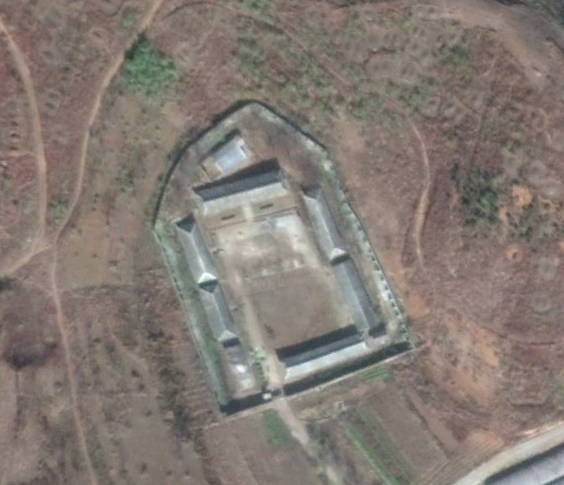
Within the #AccessDPRK Map are hundreds of "compounds". These are generally unspecified groups of buildings or walled-off compounds. I didn't know what they were for certain, but they occurred with such regularity that I felt it was important to map as many as I could. They could be small factories, perhaps barracks or police stations, food distribution centers, or even jails. The places within the "compound" classification vary widely in their configurations, but a good many seemed to follow the same basic design.

In the 2017 report The Parallel Gulag, HRNK discusses a separate, parallel prison system apart from the country's wider known system of massive concentration camps. The report details 20 sites and all share similar design characteristics between each other and the hundreds of other compounds that were mapped as part of #AccessDPRK.

Here are a few satellite images of sites discussed in The Parallel Gulag.


The site above was identified by HRNK as Kyo-hwa-so No. 2 and is located at 39°52'5.88"N 124°44'59.48"E near Tongrim, North Pyongan Province.


The site above was identified by HRNK as Kyo-hwa-so No. 88 and is located at  39°11'58.80"N 127°20'44.93"E between Munchon and Wonsan.


And this site was identified by HRNK as a likely jail in Sangtong-ri (40° 5'35.61"N 127°21'26.26"E) in South Hamgyong Province.

This next set of Google Earth images show a few of the "compounds" that were mapped as part of #AccessDPRK.


This is a site in Kangwon Province and is located at 39°13'41.87"N 127°20'22.79"E


Back in April 2017, I took to Twitter and asked people what they thought these places were. I received several suggestions, but most said they were probably associated with agriculture or food distribution. And we do know that grain warehouses and distribution points are well guarded, which would necessitate walls and guard posts. However, defector testimony has also revealed that during the famine many places were set up as detention centers to handle the huge number of orphaned children. The government simply took over any available buildings it needed and converted them to this use. They were described as little better than prisons in terms of design and security.
If you have no food but need secure buildings, former food distribution centers may have filled the role. Of course, how long the regime continued to use them for this purpose, or if they were changed to serve as another type of detention center isn't known.

With the publication of The Parallel Gulag, we can now definitively say that North Korea's system of concentration and labor camps, prisons, and local detention facilities is much larger than many realized. Considering I knew of so many similar facilities throughout the country, I reached out to North Korea analyst Joseph S. Bermudez (who also aided in the analysis of satellite imagery for the HRNK report). I gave him a few examples of the sites I had mapped, and he gave me his opinion on each one. As with Twitter, he too said they were a mix of detention facilities, barracks for local military/paramilitary units, and agricultural related facilities. However, he also said that a lot more study needed to be done.

Map showing the additional sites of interest.

Without further study and defector testimony, we may never know precisely what each of these locations are. However, I have located 632 such sites all over North Korea, which would mean there is a full order of magnitude more of these sites than fully functional hospitals in the whole of the country. With stories of "orphan jails", the now revealed parallel system of jails, the knowledge of historical "black sites" (like The Barn), and the highly secretive nature of the regime, it is safe to bet that at least some of these facilities are previously unknown prisons.

Here is a map of all the sites. If you open it up in Google Maps, you can save it as a KML for Google Earth as well.


If you have any additional information on any of these sites, please let me know!

--Jacob Bogle, 11/2/17 (updated 5/10/2019)
JacobBogle.com
Facebook.com/JacobBogle
Twitter.com/JacobBogle